
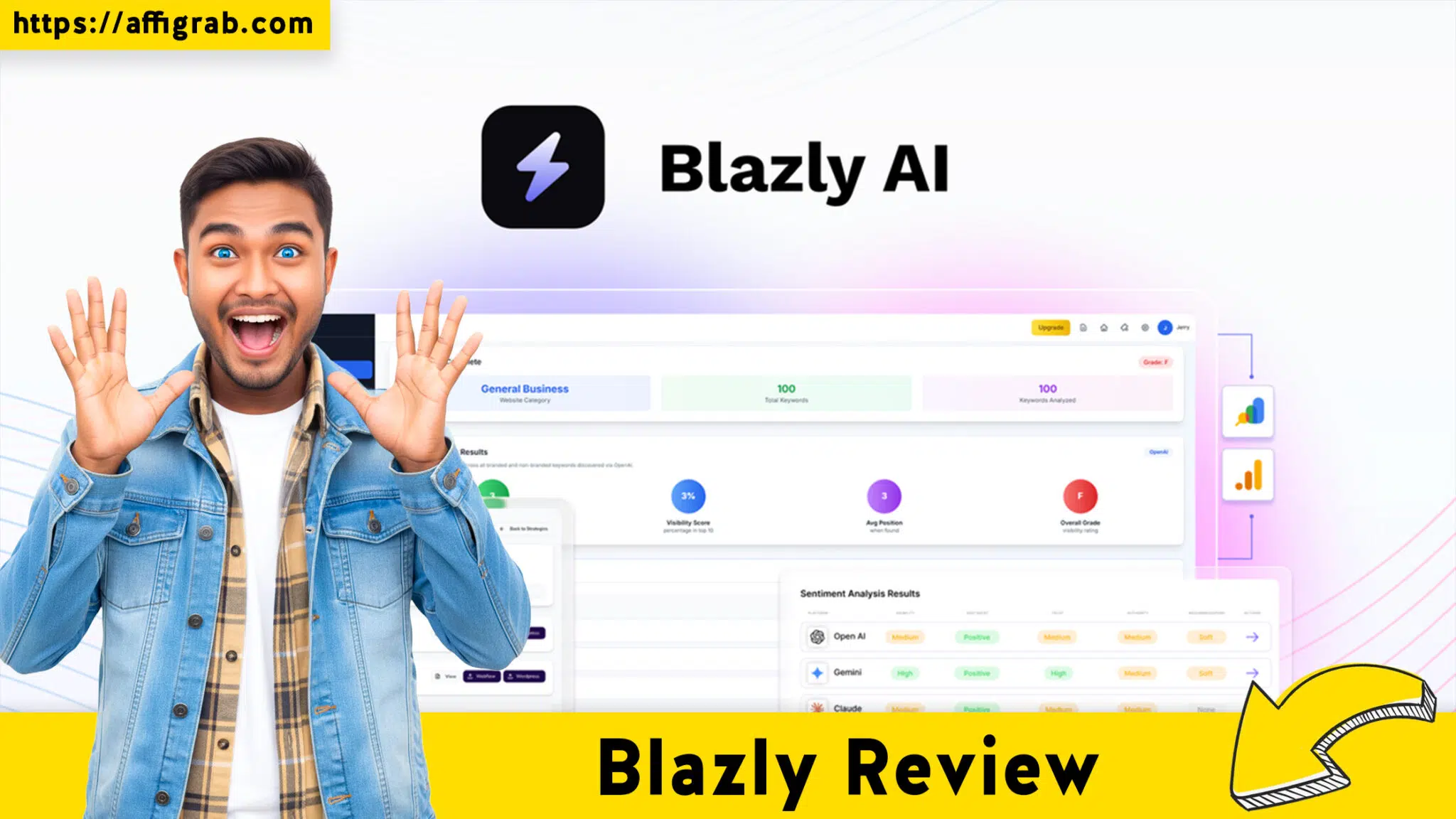
Blazly Review begins with a simple premise: the old way of doing SEO is officially dead, and Generative Engine Optimization is the new gold standard for digital dominance. As we navigate the complex landscape of 2026, the traditional blue links on search engine result pages have been largely superseded by AI-driven summaries and conversational interfaces.
Businesses that fail to adapt to this shift find themselves invisible to the very algorithms that once fueled their growth. Blazly emerges as the definitive solution to this crisis, offering a sophisticated suite of tools designed to not only rank your content but ensure it is the primary source cited by large language models.
Table of Contents
The digital ecosystem has undergone a radical transformation over the last twenty-four months. We are no longer just optimizing for Google’s crawlers; we are optimizing for the neural networks that power ChatGPT, Claude, and Gemini.
This is where the concept of a GEO health score becomes critical. Blazly provides a real-time assessment of how “AI-ready” your content truly is. It isn’t enough to have high-quality prose; your data must be structured in a way that AI agents can easily parse, trust, and reference.
This tool acts as the bridge between traditional content creation and the high-tech requirements of modern generative search.
Why Generative Engine Optimization is the 2026 Priority
In the current year, the competition for digital real-eye-balls has moved from the top of the search page to the inside of the AI response box. If your brand is not being mentioned within the personalized answers generated by AI, you are losing a massive percentage of your potential traffic.
Blazly focuses specifically on Generative Engine Optimization to ensure that your site becomes a trusted node in the global information graph. By analyzing the patterns that AI engines use to select sources, Blazly allows users to reverse-engineer visibility in a way that was previously impossible.
The shift toward AI-centric search means that “keywords” are being replaced by “entities” and “context.” Blazly’s engine is built to understand these nuances. It evaluates your existing content and suggests structural changes that align with the latest LLM update cycles.
This isn’t just about adding a few synonyms; it’s about establishing a digital footprint that screams authority to both human readers and machine learning models.

Mastering the AI Citation Flow
One of the most innovative features found within the Blazly ecosystem is the focus on AI Citation Flow. In 2026, a link from a high-authority site is still valuable, but a citation within an AI-generated answer is the ultimate conversion tool.
Blazly tracks how often your content is being used as a reference point by generative engines. This allows you to see which parts of your content strategy are actually working and which parts are being ignored by the AI.
By monitoring this flow, users can identify specific content gaps. If a competitor is consistently being cited for a specific topic, Blazly identifies the structural reasons why and helps you pivot your strategy to reclaim that authority.
It’s a game of digital chess where the prize is being the “featured source” for millions of conversational queries every single day.
Establishing a Robust Pillar-Cluster Strategy
To survive the volatility of the 2026 search market, a disorganized blog is no longer sufficient. You need a mathematically sound pillar-cluster strategy. Blazly automates the creation of these content maps, ensuring that every piece of “cluster” content feeds authority back to your main “pillar” pages.
This semantic grouping tells search engines and generative models alike that you are a comprehensive expert on a specific subject.
When you use Blazly to map out your topical authority, the tool identifies the exact sub-topics you need to cover to close the loop on a subject. This prevents “content drift” and ensures that your internal linking structure is optimized for both user experience and algorithmic crawling.
This systematic approach is the only way to build a sustainable moat around your brand in an era where AI can generate generic content in seconds.
🚀 Get Blazly Lifetime Deal Now
Overcoming the AI Content Saturation Crisis
The internet is currently being flooded with low-quality, AI-generated “slop” that provides zero value to the end-user. Search engines have responded by aggressively penalizing content that feels robotic or derivative. Blazly addresses this head-on by providing tools that help creators refine their output.
The goal is to produce content that has the efficiency of AI but the soul and unique insight of a human expert.
Many businesses made the mistake in 2025 of purely automating their content desks, only to see their rankings vanish during the major core updates of early 2026. Blazly serves as a safety net, providing the analytical data needed to ensure your content provides “Information Gain”—the metric of providing new, unique information that hasn’t been scraped a thousand times before.
Leveraging the GEO Health Score for Maximum Impact
Your GEO health score is perhaps the most important metric inside the Blazly dashboard. This score is a culmination of various factors: technical schema, factual density, and source credibility.
A high score indicates that your page is highly likely to be picked up as a primary source for AI summaries. Blazly doesn’t just give you a number; it provides a checklist of actionable items to improve that score.
Whether it’s reformatting your data into tables that AI prefers or adjusting the sentiment of your conclusions to match user intent, the tool guides you through the process of modern optimization.
In an age where transparency and trust are the primary currencies of the web, having a high health score is the equivalent of a “verified” badge for your content’s accuracy and relevance.
Real-Time Adaptability in an Evolving Market
The speed at which search technology is moving in 2026 is unprecedented. A strategy that worked in January might be obsolete by March. Blazly’s real-time data integration ensures that you aren’t working with stale information.
By pulling live data from AppSumo and other market indicators, Blazly keeps its users ahead of the curve.
This adaptability is what separates a “tool” from a “partner.” Blazly functions as an AI-driven consultant that is constantly scanning the horizon for the next shift in generative engine behavior.
For the small business owner or the independent agency, this level of insight was previously locked behind enterprise-level price tags. With the lifetime deal, that barrier is removed, allowing anyone to compete with the giants of the industry.
The core value proposition of a Blazly Review in 2026 centers on its ability to navigate a landscape where traditional search is no longer the only game in town. This platform has been engineered to solve the “black box” problem of AI visibility, providing creators with a suite of tools that manage everything from topical mapping to final output refinement.
To understand why this tool has become a staple for digital agencies, one must look at the specific features that drive its Generative Engine Optimization capabilities.
One of the standout features is the automated Pillar-cluster strategy generator. Instead of manually guessing which topics link together to build authority, the software analyzes the current competitive landscape and dictates exactly which supporting articles are needed to bolster a main pillar page.
This ensures that your site structure is logically sound for both human readers and the semantic crawlers used by modern search engines. When this is paired with the GEO health score, users get a real-time diagnostic of how likely their content is to be featured in AI-generated summaries across platforms like ChatGPT or Perplexity.
Another critical component is the AI visibility tracker. This isn’t your standard rank tracker that tells you if you are in position one or five on Google. Instead, it monitors how often your brand or specific content pieces are being pulled into conversational AI responses.
This is vital for maintaining a high AI Citation Flow, which is the 2026 equivalent of backlink authority. If the generative engines aren’t citing you, you effectively don’t exist for a growing segment of the searching population.

Detailed Feature Analysis and Blazly Review of Capabilities
The technical sophistication of the platform extends into Brand sentiment analysis. In an era where AI models are trained on public perception, knowing how your brand is discussed across the web is paramount. Blazly scans mentions and citations to provide a sentiment map, allowing users to pivot their PR or content efforts if the AI starts associating their brand with negative or inaccurate contexts.
This data is then used to Humanize AI content, ensuring that the final output doesn’t just pass a “bot check” but actually resonates with the emotional and intellectual needs of a human audience.
For those managing large-scale operations, the Automated CMS publishing feature is a lifesaver. It allows for a seamless transition from the research and writing phase directly into a WordPress or Shopify environment.
This speed is essential when trying to capitalize on trending topics or closing Competitor citation gaps. By seeing exactly where your competitors are being cited by AI and you are not, you can rapidly produce high-quality, AI-ready landing pages that target those specific information voids.
Understanding the Blazly Review of AppSumo License Tiers
When evaluating the investment for this tool, the AppSumo lifetime deal structure provides a clear path for scaling. Each tier is designed to meet the needs of different user levels, from solo bloggers to massive content agencies.
License Tier 1 is priced at $79. This entry-level tier is perfect for individuals or small startups looking to establish their first foothold in the world of AI search. It includes all the foundational features such as the Generative Engine Optimization suite and basic tracking for a limited number of keywords and projects.
It is the most cost-effective way to start monitoring your GEO health score without a massive upfront commitment.
License Tier 2 is priced at $159. This tier typically doubles or triples the limits found in Tier 1, making it the sweet spot for growing businesses.
At this level, the Pillar-cluster strategy tools become more robust, allowing for more complex site architectures and deeper competitor analysis. It provides the breathing room necessary to manage multiple niche sites or a single large-authority site with thousands of pages.
Advanced Scaling with Higher License Tiers
As we move into the professional and agency categories, the limits expand significantly to accommodate high-volume content production and monitoring.
License Tier 3 is priced at $299. This tier is built for established agencies that need to prove ROI to their clients through the AI visibility tracker.
With expanded limits on brand sentiment analysis and automated CMS publishing, Tier 3 allows an agency to handle a dozen or more clients simultaneously while maintaining a high standard of output. The focus here is on efficiency and the ability to close competitor citation gaps across various industries.
License Tier 4 is priced at $499. This is the “Unlimited” or “Max” tier designed for enterprise-level operations. At $499, users gain the highest possible limits for creating AI-ready landing pages and maximizing their AI Citation Flow.
For a company producing hundreds of articles a month, the ability to humanize AI content at scale and verify every piece against the GEO health score is invaluable. This tier ensures that no matter how much the AI landscape shifts, the user has the technical resources to adapt instantly.
Real-World Use Cases for the 2026 SEO Professional
To truly appreciate the power of these features, one must look at how they are applied in the field. Imagine a local service business that is struggling to appear in “near me” AI queries.
By using the competitor citation gaps tool, the business owner can see that AI models are citing a competitor because that competitor has more structured data regarding their specific service area. Blazly then helps the user generate AI-ready landing pages that are specifically formatted to be parsed by LLMs, effectively “stealing” the citation in the next model update.
Furthermore, the pillar-cluster strategy ensures that the business doesn’t just have one lucky page, but a whole web of relevant content that establishes them as the local authority. The automated CMS publishing means these updates can happen in minutes rather than days, allowing the business to react to local trends or news as they happen.
Maximizing the AI Citation Flow
In the context of a Blazly Review, the concept of “flow” is perhaps the most important metric for the next decade. Unlike a static backlink, a citation flow is dynamic. As AI models are updated or retrained, they look for the most current, relevant, and well-structured data.
Blazly’s real-time monitoring tells you the moment your citation count drops, signaling that a competitor has likely produced a more “authoritative” or “humanized” piece of content.
By utilizing the brand sentiment analysis, you can also ensure that when you are cited, it is in a positive light. AI models are remarkably sensitive to context; if your brand is frequently mentioned in the same breath as “scam” or “poor quality,” the generative engines will learn to avoid recommending you.
Blazly gives you the tools to identify these negative associations and counter them with high-quality, verified content that improves your standing in the neural networks of search.
Building for the Long Term with AI-Ready Landing Pages
The shift toward “Zero-Click” search, where the user gets their answer directly from the AI without ever visiting a website, has terrified many marketers. However, Blazly turns this threat into an opportunity.
By creating AI-ready landing pages, you aren’t just trying to get a click; you are trying to become the knowledge base for the AI itself.
When an AI cites your landing page, it often provides a source link. While the click-through rate might be lower than traditional search, the quality of that traffic is significantly higher.
A user who clicks a source link in a ChatGPT response is a user who is looking for deep-dive verification or is ready to make a purchase. Using the humanize AI content feature ensures that once that user does land on your site, they find content that feels personal, authoritative, and helpful, leading to much higher conversion rates than generic, robotic landing pages of the past.
The pricing structure on AppSumo reflects this long-term value. Whether you are at the $79 Tier 1 or the $499 Tier 4, the goal remains the same: staying relevant in an AI-first world.
The lifetime deal removes the burden of monthly subscriptions, allowing you to reinvest those savings into your actual content and product development, while Blazly handles the complex mathematics of modern Generative Engine Optimization.
The transition from traditional search to an AI-first ecosystem is no longer a prediction; it is the reality of 2026. In this landscape, a tool like Blazly is not just a luxury but a necessity for maintaining digital relevance.
By bridging the gap between standard SEO and the emerging field of Generative Engine Optimization, it provides a comprehensive roadmap for brands that want to be more than just a link on a page—they want to be the answer provided by the world’s most powerful AI models.
🔗 Click Here for the Blazly Offer
Competitor Comparison: Blazly vs. The Industry Giants
To understand the value of the Blazly lifetime deal, we must compare it to the heavy hitters that have dominated the market for years. While many tools are beginning to integrate AI features, their pricing structures remain rooted in the traditional SaaS subscription model, which can become a significant overhead for growing agencies.
1. Surfer SEO
Surfer SEO is perhaps the most well-known name in content optimization. As of 2026, its Essential Plan starts at $99/month, while the Scale Plan jumps to $219/month. Unlike Blazly’s lifetime offer, Surfer is a strictly Monthly Subscription (SaaS). While Surfer excels at granular on-page technical data, it charges an additional $95/month add-on for its “AI Tracker” to monitor visibility in AI search. Blazly includes these GEO features within its core license tiers, providing a much higher value-to-cost ratio.
2. NeuronWriter
NeuronWriter is the closest competitor in terms of philosophy and target audience. It currently offers a Monthly Subscription starting at $23/month, but it frequently runs Lifetime Deals on AppSumo starting at $109.
While NeuronWriter is a powerhouse for semantic SEO and NLP optimization, Blazly’s unique edge lies in its specific focus on AI Citation Flow and Brand sentiment analysis, features that are more advanced in Blazly’s 2026 toolkit compared to NeuronWriter’s standard content editor.
3. Frase.io
Frase remains a favorite for content teams, with its Starter Plan priced at $49/month and the Professional Plan at $129/month. Like Surfer, it follows a Monthly Subscription model.
Frase is excellent for research and brief building, but Blazly’s automated Pillar-cluster strategy and its ability to generate AI-ready landing pages in a single workflow give it a distinct advantage for those looking to dominate generative search engines like Perplexity and Gemini.

Blazly Review: Pros & Cons
Pros:
- One-Time Cost: The lifetime deal starting at $79 eliminates recurring monthly SaaS fees.
- GEO Focus: Built specifically for the 2026 search environment, focusing on AI citations rather than just keyword density.
- Workflow Integration: Includes humanization, publishing, and strategy in one dashboard.
- Scalability: License Tier 4 offers massive limits suitable for large-scale agency operations.
- Direct CMS Publishing: Saves hours by pushing formatted content directly to WordPress or Webflow.
Cons:
- Learning Curve: The shift from SEO to GEO requires a change in mindset and strategy.
- Newer Platform: While innovative, it may lack some of the decade-old legacy data found in tools like Ahrefs.
- Niche Focus: Users purely interested in technical “old-school” SEO might find the GEO tools more than they need.
FAQ: Master Your Generative Engine Optimization Strategy
Q: How does the GEO health score differ from a standard SEO score?
A: A standard SEO score looks at keyword density, H1 tags, and alt text. The GEO health score analyzes your content’s “citability” by LLMs. It looks for factual density, structured data, and authoritative sentiment—the metrics that ChatGPT and Claude use to decide which source to cite in an answer.
Q: Can I really Humanize AI content to pass 2026 detection?
A: Yes. Blazly uses a specialized “humanizer” layer that adjusts syntax, introduces anecdotal phrasing, and varies sentence structure. This ensures your content avoids the robotic patterns that search engines now penalize, maintaining your brand’s integrity.
Q: What is a Competitor citation gap and why should I care?
A: This tool identifies instances where an AI engine (like Gemini) cites your competitor for a specific query but ignores your site. By identifying this gap, you can create AI-ready landing pages that provide better data to the model, allowing you to “steal” that citation.
Q: Is the Pillar-cluster strategy automated?
A: Entirely. You provide a core topic, and Blazly maps out the internal linking and sub-topics needed to build topical authority. This ensures the AI visibility tracker sees your site as a comprehensive resource rather than a collection of random posts.
Q: Does the tool help with Brand sentiment analysis?
A: Absolutely. In 2026, AI models recommend brands they “trust.” Blazly monitors how your brand is discussed online and provides a sentiment score. If the sentiment is trending negatively, it suggests content pivots to improve your standing in the generative search index.
Q: How do I maximize my AI Citation Flow?
A: By consistently hitting high scores on your GEO audits and ensuring your content is published via the Automated CMS publishing tool with the correct schema markup. The more “parseable” your high-quality data is, the higher your citation flow will become.
The Final Verdict
The digital marketing world has reached a tipping point. In 2026, ranking on page one of Google is only half the battle; the real victory is being the voice behind the AI’s answer. Blazly is the first tool of its kind to treat Generative Engine Optimization as a primary discipline rather than an afterthought.
For freelancers and small business owners, License Tier 1 at $79 is an unbeatable entry point into the future of search. For agencies, the “unlimited” feel of License Tier 4 at $499 provides the competitive edge needed to dominate Competitor citation gaps across multiple niches.
When you consider that the alternative is paying $2,000+ per year for a suite of subscription tools like Surfer or Frase, the choice becomes clear.
If you want to stop chasing algorithms and start leading them, Blazly is the investment your brand needs. Secure the lifetime deal on AppSumo today and ensure your content stays at the forefront of the AI revolution.