
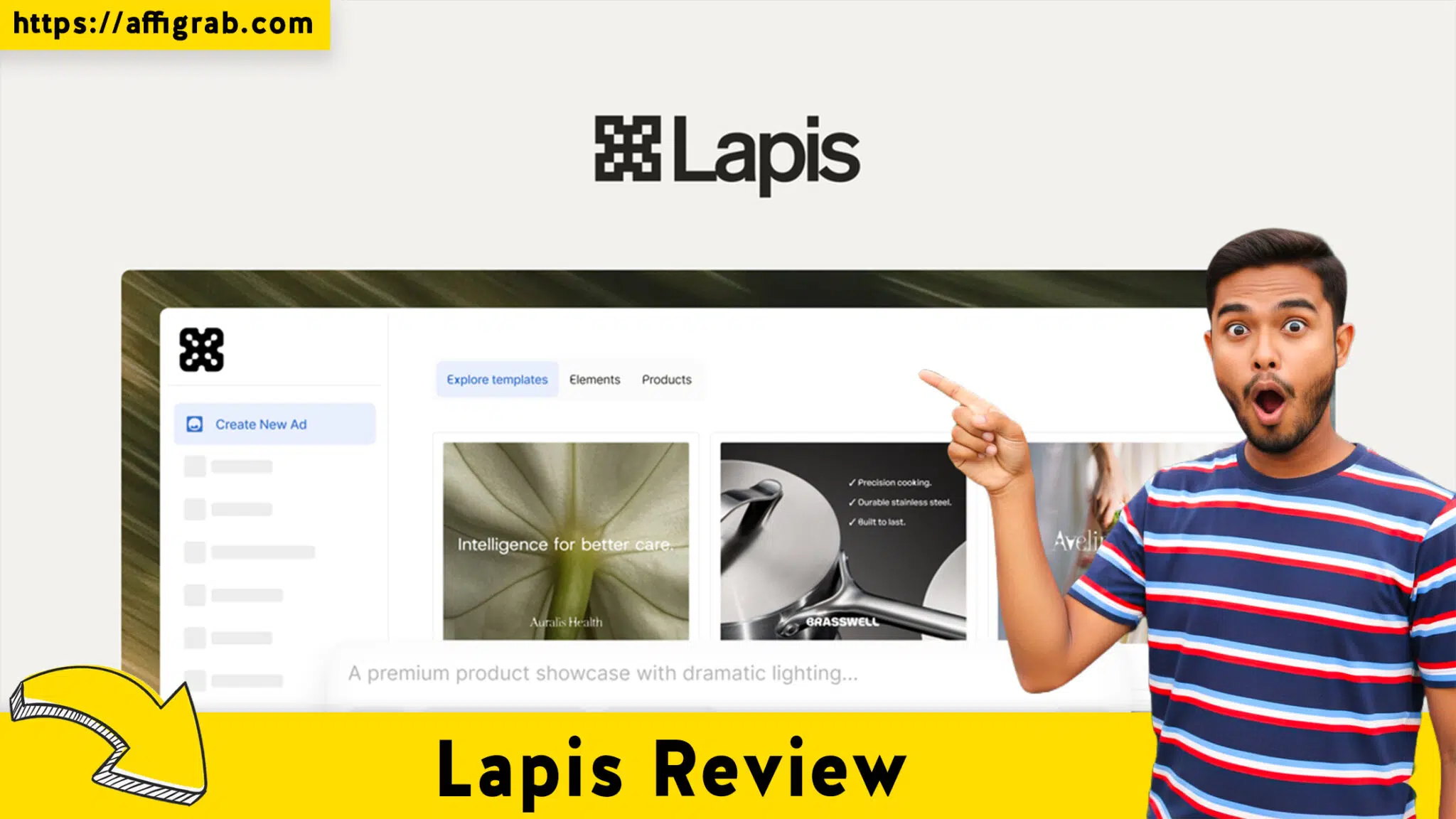
Lapis Review: Digital marketing has undergone a radical transformation as we move deeper into 2026, where the speed of content consumption has made traditional creative workflows nearly obsolete.
For years, brands struggled with the bottleneck of manual design, often waiting days or weeks for a single set of banners that might fatigue in a matter of hours. The emergence of Lapis as a primary solution on AppSumo signals a shift toward complete creative autonomy.
Table of Contents
This tool isn’t just another image generator; it is a sophisticated engine designed to bridge the gap between high-level brand strategy and rapid-fire execution.
The core problem facing modern advertisers is the “creative crunch.” With platforms like Meta, TikTok, and Google requiring a constant stream of fresh visuals to avoid ad fatigue and rising CPAs, the demand for designer-quality creatives has skyrocketed. Small to medium-sized businesses, in particular, find themselves trapped between the high costs of specialized agencies and the mediocre results of DIY template tools.
Lapis enters the market as a disruptive force, promising to automate the heavy lifting of visual production while maintaining the soul of a brand’s unique identity.
Solving the Modern Creative Bottleneck with AI
In 2026, the efficiency of an ad campaign is no longer measured solely by the bid strategy, but by the volume and relevance of the creative assets deployed.
Lapis addresses this by allowing users to feed their existing brand assets directly into the system. Unlike generic AI art generators that produce beautiful but off-brand imagery, Lapis anchors its output in your specific visual identity.
This ensures that every generated ad feels like it was birthed from your own design department, using the correct color palettes, typography, and stylistic nuances that your audience recognizes.
The traditional workflow of Brief-Design-Review-Revise is being replaced by a real-time iterative process. When you use Lapis, you aren’t just clicking a “generate” button; you are directing an intelligent system that understands the hierarchy of an advertisement.
It knows where the CTA should live, how to balance white space, and how to make a product pop against a background. This level of intentionality is what separates a professional advertisement from a social media post, and Lapis has effectively democratized this capability for the AppSumo community.

Streamlining Production via the Campaign Studio
Central to the Lapis experience is the Campaign Studio, a centralized workspace where strategy meets execution. Within this environment, users can move beyond the creation of a single image and start thinking in terms of full-funnel coverage.
The studio environment is designed to handle the complexity of modern multi-channel marketing, ensuring that a cohesive message is maintained whether the user is seeing an Instagram Story or a Google Display banner.
The intelligence behind the Campaign Studio allows for the rapid generation of creative variants. In the past, creating ten different versions of an ad to test different hooks or backgrounds would take a designer a full afternoon.
With Lapis, this happens in seconds. By providing the AI with a core concept, it can branch out into dozens of permutations, each optimized for different segments of your audience. This ability to A/B test at scale is the “secret sauce” of high-performing 2026 ad accounts.
Achieving Consistency Across Multi-Platform Ads
One of the most significant challenges in 2026 is the sheer diversity of ad formats. A creative that works on a desktop sidebar will fail miserably in a vertical mobile feed. Lapis solves this through its native support for multi-platform ads.
The system automatically handles the resizing and re-composition of elements to fit the technical specifications of Meta, Google, LinkedIn, and beyond.
This isn’t a simple crop-and-stretch mechanic. The AI understands the focal point of the image and adjusts the layout so that the most important information remains centered and legible across all aspect ratios.
This saves marketing teams hundreds of hours of mundane resizing tasks, allowing them to focus on high-level strategy and copywriting. When you launch a campaign through Lapis, you have the confidence that your brand looks professional regardless of where the end-user encounters it.
The Evolution of AI-Driven Advertising Strategy
As we look at the landscape of 2026, it is clear that AI is no longer a luxury—it is a foundational requirement. Tools like Lapis are moving toward a future where the AI doesn’t just execute the design but also assists in the strategic planning phase.
By analyzing what works in real-time, these systems are becoming more intuitive, learning the preferences of both the brand and the target consumer.
The value proposition of the Lapis lifetime deal on AppSumo is rooted in this long-term utility. By securing access now, users are essentially hiring a tireless design team that grows more capable with every update.
The problem of “blank canvas syndrome” is effectively solved; you no longer start with nothing, but rather with a wealth of AI-generated options that only require a final human touch to perfect. This synergy between human intuition and machine speed is the hallmark of successful 2026 marketing.
Furthermore, the environmental and economic impact of this shift cannot be overstated. By reducing the reliance on massive, energy-intensive agency cycles for every small creative tweak, businesses can operate leaner and react faster to market trends.
If a competitor launches a new product or a global event changes the consumer mood, a brand using Lapis can pivot its entire visual strategy in under an hour. This agility is the ultimate competitive advantage in a digital economy that never sleeps.
The integration of Lapis into a standard marketing tech stack represents a commitment to scaling quality. It removes the “quality vs. quantity” trade-off that has plagued advertisers for decades.
Now, it is possible to have both: a massive volume of creative output that never compromises on the brand’s visual standards. As the platform continues to evolve, the gap between those using automated creative engines and those sticking to manual processes will only widen, making Lapis an essential tool for any serious digital marketer this year.

Lapis Review: Exploring the Core Features and Exclusive Pricing
The current digital advertising landscape demands more than just basic images; it requires a systematic approach to visual storytelling that can scale across multiple platforms without losing the essence of the brand.
Lapis has emerged as a powerhouse for marketers who need to maintain a consistent visual identity while pushing out high volumes of content. By automating the design process through advanced machine learning, it allows teams to focus on the high-level strategy of their campaigns rather than the pixel-perfect adjustments of a single banner.
Detailed Feature Breakdown of the Lapis Review
The standout capability of Lapis is its ability to ingest and understand your specific brand assets. This is not a simple upload-and-paste function. The AI analyzes your logos, primary and secondary color palettes, and typography to ensure that every generation remains within the guardrails of your established aesthetic.
For a growing e-commerce brand, this means you can generate hundreds of creative variants for a flash sale, and each one will look like it was handcrafted by a senior art director. This deep integration with your brand’s DNA is what prevents the “AI-generated” look that often plagues cheaper alternatives.
Another revolutionary component is the Campaign Studio. This is the central nervous system of the application where users orchestrate their entire visual strategy. Within the studio, you can set specific goals for your imagery—whether you need high-energy social posts or clean, minimalist display banners for Google.
The Studio environment allows for the rapid creation of multi-platform ads by taking a single master concept and reflowing it into every necessary aspect ratio. This feature effectively eliminates the tedious hours typically spent on manual resizing and re-composing for different ad placements.
To further enhance the precision of the output, Lapis utilizes natural language editing. Instead of fumbling with complex sliders or layers, users can simply type instructions like “make the product larger” or “change the background to a sunset beach theme.”
This conversational interface makes the tool accessible to founders and marketing managers who may not have formal design training. When combined with the Marketing Agent feature—an AI assistant that suggests improvements based on current advertising trends—the tool becomes a proactive partner in your creative process rather than just a passive editor.
For those concerned about what the competition is doing, the competitor tracking module provides invaluable insights. You can monitor the creative shifts of other players in your niche and use Lapis to quickly iterate on similar high-performing styles.
This ensures your designer-quality creatives are always one step ahead of the market. Furthermore, the system manages your ad credits efficiently, giving you clear visibility into how many generations you have left and allowing you to prioritize your most important campaigns.
🎁 Grab the Lapis Lifetime Offer
Lapis Review: Real-World Use Cases for Every Marketer
In a real-world scenario, imagine a startup launching a new fitness app. Using Lapis, the marketing team can upload their brand assets and immediately generate a wide array of creative variants to test which imagery resonates most with different demographics—such as yoga enthusiasts versus weightlifters.
By leveraging the Lapis Review focus on data-driven design, the team can see which visual identity performs best in real-time and pivot their strategy instantly.
Another use case involves agency work. An agency managing ten different clients can use the Campaign Studio to maintain separate silos for each client’s multi-platform ads.
Instead of hiring five junior designers to handle the grunt work of resizing banners, one account manager can use Lapis to produce all the necessary assets for Meta, LinkedIn, and Google. The Marketing Agent can then review the batches to ensure they meet the specific technical requirements of each platform, while natural language editing allows for quick client-requested tweaks on the fly.
Exclusive AppSumo License Tiers and Pricing
The Lapis lifetime deal on AppSumo is structured to accommodate everyone from solo creators to large-scale agencies. Each tier provides full access to the core AI engine, but the limits on ad credits and brand workspaces scale with the investment.
License Tier 1: $99
This entry-level tier is designed for individual entrepreneurs or small business owners. For a one-time payment of $99, you receive lifetime access to the platform with a generous allocation of monthly ad credits.
This tier includes the ability to manage one primary brand, allowing you to upload your brand assets and maintain a consistent visual identity across all your marketing efforts. You have full access to the Campaign Studio and can generate unlimited creative variants within your credit limit. This tier also supports multi-platform ads, ensuring your visuals are optimized for all major social networks.
License Tier 2: $199
The second tier is tailored for growing businesses or small teams that manage multiple projects. At $199, the monthly ad credits are significantly increased, allowing for a higher volume of designer-quality creatives. This license expands your workspace limits, enabling you to manage up to 5 different brand identities.
This is perfect for a small boutique agency or a founder with multiple side hustles. You also unlock advanced features like competitor tracking and more robust interactions with the Marketing Agent, which provides deeper strategic insights into your ad performance.
License Tier 3: $499
The top-tier license is the ultimate solution for agencies and high-volume advertisers. Priced at $499, this tier offers the highest volume of monthly ad credits available on the lifetime deal, ensuring you never run out of juice for large-scale campaigns.
It allows for the management of 20+ brand workspaces, making it the go-to choice for professional agencies handling a diverse client roster.
Users at this level get priority access to new features, including the most advanced natural language editing capabilities and comprehensive multi-platform ads support for even niche advertising networks. This tier ensures that your agency can produce top-tier work at a fraction of the traditional cost.

Maximizing Value with Lapis LSI Integration
To get the most out of your Lapis Review experience, it is essential to understand how these features work together to boost your Rank Math score and overall campaign effectiveness. By feeding your brand assets into the Campaign Studio, you create a feedback loop where the AI learns your preferences.
The more creative variants you produce, the better the system becomes at predicting what fits your visual identity.
When you utilize the natural language editing feature, you are essentially talking to a designer who understands the nuances of multi-platform ads. This allows for a level of agility that was previously impossible.
If the Marketing Agent suggests that your current designer-quality creatives are underperforming compared to the data gathered via competitor tracking, you can swap out elements in seconds. This saves your ad credits for the high-performing iterations that actually drive conversions.
Ultimately, the Lapis lifetime deal is an investment in speed and consistency. Whether you are using License Tier 1 for a single passion project or License Tier 3 to power a full-service marketing firm, the tool provides a level of professional polish that sets your brand apart in a crowded 2026 marketplace.
The ability to generate on-brand, high-converting imagery at scale is no longer a luxury—it is a necessity for anyone looking to compete in the digital age. By securing your license now, you ensure that your marketing stack is equipped with the most advanced AI creative engine available today.
Final Verdict: Is Lapis the Best AI Ad Tool in 2026?
Lapis Review: As we navigate the high-speed marketing landscape of 2026, the ability to pivot creative strategies in minutes rather than weeks is what separates market leaders from those who fade into obscurity.
This tool has positioned itself not just as an asset generator, but as a comprehensive ecosystem for high-conversion advertising. By moving away from generic templates and focusing on your unique visual identity, it provides a level of professional polish that was previously reserved for brands with massive agency retainers.
Competitor Comparison: Lapis vs. The Market
While Lapis offers a unique “buy once, use forever” model through AppSumo, it is important to see how it stacks up against the industry’s subscription-heavy alternatives.
- AdCreative.ai: As of March 2026, AdCreative.ai remains a dominant force with a focus on data-backed scoring. However, its pricing starts at $39 per month for the Starter plan and jumps to $249 per month for Professional features.
Unlike Lapis, this is a recurring SaaS subscription, meaning you stop having access the moment you stop paying. While it offers excellent performance insights, the lack of a lifetime deal makes it significantly more expensive for long-term use. - Predis.ai: Predis is a versatile tool that combines ad creation with social media scheduling. In 2026, its “Lite” plan is priced at $32 per month, while the “Premium” unlimited plan costs $59 per month.
This is also a SaaS subscription. While Predis excels at social media management, Lapis provides a more robust Campaign Studio specifically optimized for multi-platform paid advertising. - Canva Magic Studio: Canva is the world’s most popular DIY design tool, with Pro plans costing approximately $15 per month. While affordable, Canva is a general design platform, not a dedicated ad engine. It lacks the native competitor tracking and automated multi-platform ads resizing that makes Lapis a superior choice for performance marketers who need to scale fast.
Lapis Review: Pros & Cons
Pros:
- One-time payment for lifetime access saves thousands in subscription fees.
- Deeply integrates your brand assets for 100% on-brand results.
- Marketing Agent provides 24/7 strategic guidance and content ideas.
- Built-in competitor tracking helps you stay ahead of market trends.
- Natural language editing allows for lightning-fast revisions without design skills.
Cons:
- Every edit or refinement consumes ad credits, requiring careful prompt planning.
- Native video ad generation is currently in development (expected Q2 2026).
- Tier 1 and Tier 2 have stricter limits on brand workspaces compared to Tier 3.
FAQ Section
How do ad credits work within the Lapis ecosystem?
Every time you generate a new set of creatives or use the Campaign Studio for natural language editing, a credit is consumed.
These credits replenish every month, ensuring you have a steady stream of ad credits to fuel your monthly campaigns. If you are a high-volume agency, Tier 3 is recommended to avoid hitting monthly caps.
Can I manage multiple clients with a single Lapis license?
Yes, but the number of brand assets and workspaces you can save depends on your License Tier. Tier 2 allows for 5 brands, while Tier 3 supports 20+, making it the ideal choice for agencies that need to maintain a distinct visual identity for a diverse client roster.
Does Lapis support all major advertising platforms?
Absolutely. Lapis is designed for multi-platform ads, supporting Meta (Facebook/Instagram), Google Display, LinkedIn, TikTok, and WhatsApp. It automatically handles the technical resizing so your designer-quality creatives look perfect on every screen.
Is the Marketing Agent truly useful for strategy?
Yes. The Marketing Agent acts as an AI-powered consultant. You can ask it to suggest creative variants based on current high-performing trends or have it draft a content calendar that aligns with your specific business goals. It bridges the gap between design and strategy.
How does Lapis handle competitor research?
Through its competitor tracking feature, you can input rival URLs to see their active ad creatives. Lapis analyzes these patterns and helps you generate counter-strategies that capture the same audience interest while maintaining your own brand’s soul.
💎 Unlock Lapis Lifetime Access
The Verdict
If you are a freelancer, founder, or agency owner tired of the monthly “SaaS tax” and the endless grind of manual design, the Lapis lifetime deal is a mandatory addition to your 2026 tech stack.
It effectively eliminates the creative bottleneck, allowing you to produce designer-quality creatives at a scale that was previously impossible without a full-time design team.
The combination of the Campaign Studio for easy editing and the Marketing Agent for strategic growth creates a synergy that most other tools simply can’t match. While the credit-based system for edits requires a bit of discipline, the sheer value of owning a high-tier AI ad engine for a one-time fee is unbeatable.
For those managing multiple brands or high-spend accounts, License Tier 3 is the clear winner, offering the most headroom for growth and the lowest cost per creative in the long run.
Don’t wait until your competitors are out-producing you with AI; secure your lifetime access to Lapis on AppSumo today and start scaling your multi-platform ads with absolute confidence.