
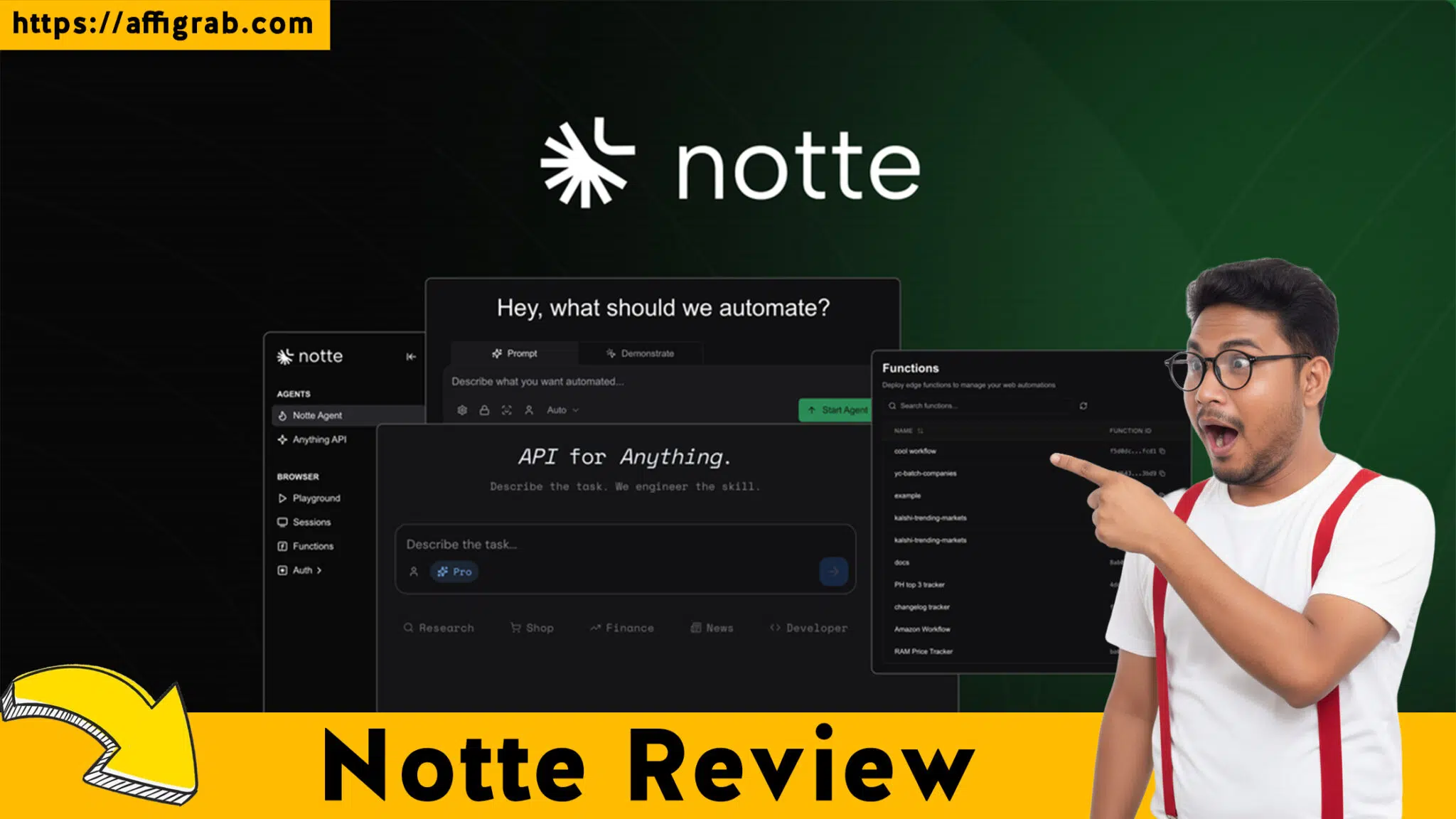
Notte Review is essential for anyone looking to build robust browser automations without the typical headache of maintaining complex scrapers or configuring headless infrastructure. In 2026, the digital landscape moves faster than ever, and traditional web scraping techniques are rapidly breaking down.
Websites deploy sophisticated anti-bot measures, dynamic JavaScript execution, and continuously changing user interfaces that easily break brittle, hard-coded scripts. This constantly evolving web ecosystem demands a smarter approach to data extraction and workflow automation.
Table of Contents
Instead of spending countless hours writing custom fallback logic or constantly updating DOM selectors, developers and businesses are turning to artificial intelligence to handle the heavy lifting.
This tool addresses that exact pain point by leveraging autonomous AI web agents capable of interacting with websites just like a human would. By transforming complex, multi-step browser interactions into resilient, production-ready workflows, it fills a massive gap in the modern data-gathering pipeline.
Whether you need to monitor competitors, aggregate pricing information, or automate repetitive form submissions, this platform aims to make the process completely seamless and hands-off.

The Evolution of Cloud Browser Automation in 2026
The automation market has undergone a dramatic shift over the past year. Legacy frameworks that relied heavily on rigid path finding often fail the moment a website shifts a button by a few pixels or alters a class name.
In 2026, relying solely on basic browser automation scripts is a recipe for constant maintenance and broken integrations. Security systems have also grown incredibly advanced, making it nearly impossible to run simple headless browsers from standard data center IP addresses without getting immediately blocked by firewalls or hit with complex verification screens.
To combat these challenges, teams require a cloud browser infrastructure that is natively resilient. This platform solves the structural weaknesses of old-school scraping by executing tasks within an isolated, scalable cloud environment.
It doesn’t just read the underlying HTML code; it visually and contextually understands the page layout. When a targeted website modifies its structure, the internal AI automatically adapts to find the correct data fields, cutting down script maintenance time to practically zero.
This paradigm shift allows teams to scale their data operations without scaling their engineering overhead, keeping workflows running smoothly behind the scenes.
🚀 Grab the Notte Lifetime Deal Before It’s Gone!
Overcoming Modern Anti-Bot Redirection
One of the biggest hurdles when pulling data at scale is avoiding detection. Websites actively track traffic patterns, device fingerprints, and request frequencies to block automated scripts. This platform addresses this issue head-on by routing your automated tasks through an elite pool of residential proxies. Because the traffic appears to originate from legitimate, household internet connections rather than a recognizable data center, the risk of getting IP-banned or throttled drops exponentially.
Seamless Integration and Execution
Furthermore, advanced tasks often require navigating past gatekeepers designed specifically to stop automated tools. The inclusion of automated CAPTCHA solving guarantees that your workflows do not grind to a halt when confronted with unexpected security prompts.
The system detects these challenges in real time, solves them programmatically in the background, and proceeds with the requested workflow. This combination of rotating residential networks and automated bypass mechanics ensures an incredibly high success rate for even the most strictly guarded target platforms.
Why Legacy Visual Selectors Fail and How AI Fixes It
For years, point-and-click automation builders relied on rigid visual selectors to identify elements like buttons, input fields, or text blocks. While these tools promised a no-code paradise, they created a maintenance nightmare because any underlying code updates rendered the selector useless.
The modern approach completely bypasses these fragile paths by letting you describe what you want in plain English. The underlying AI agent analyzes the page, identifies the correct element based on context, and executes the action safely.
This intelligence means your automation workflows are no longer tied to specific CSS classes or XPath strings. If a checkout button changes from “Buy Now” to “Proceed to Payment,” a standard script would fail, but an AI-driven agent effortlessly recognizes the intent and clicks the correct element.
This level of adaptability makes web automation accessible to a much broader audience, shifting the focus away from technical troubleshooting and toward strategic data utilization.
Accelerating Development Cycles
Building and deploying automated tasks is remarkably fast thanks to modern developer tools. With a native Python SDK, engineers can easily initialize web agents, pass natural language instructions, and handle outputs directly within their existing codebases.
There is no need to configure complex browser binaries, manage local WebDriver instances, or handle messy environment variables. A few lines of code are all it takes to trigger complex, multi-page data collection routines directly from your local IDE or CI/CD pipeline.
Turning Web Pages into Scalable APIs
The ultimate goal of modern automation is to integrate external data directly into your apps and internal dashboards. This platform excels at converting any arbitrary web interface into structured, serverless API endpoints. Instead of managing heavy servers to run persistent cron jobs, you can call a custom API endpoint whenever you need fresh data.
The system spins up a cloud browser instance on demand, executes the necessary navigation, extracts the precise information requested, and returns it as a clean JSON payload, allowing you to consume web data as easily as any standard developer API.
Deep-Dive into AI-Powered Web Automation Capabilities
Modern web architectures require scalable, resilient tools to bypass security protocols and maintain script structural integrity. When handling critical automated tasks, reliance on legacy systems can cost businesses massive resources in continuous software patches.
This platform aims to redefine how engineers interact with external websites by introducing a localized cloud ecosystem that completely manages runtime dependencies, visual recognition elements, and execution states.
A core advantage of utilizing this system is the elimination of localized resource constraints. Traditional scripts executed via local headless browsers tie up local processing power and are constrained by a single network IP footprint. By shifting the architecture directly to managed infrastructure, you gain access to an enterprise-grade cloud browser environment optimized specifically for concurrent multi-threaded execution.
These virtual browser sessions run independently, maintaining distinct browser cookies, session states, and device configurations so that your target targets view each interaction as a unique, legitimate user footprint.

Streamlining Development and Debugging Workflows
Building complex scraping networks typically involves long cycles of trial and error. To combat this friction, the integrated Demonstration Mode changes how scripts are initialized. Instead of manually inspecting elements and coding individual steps blind, developers can activate a visual debugging environment that graphically loops through user tasks.
This means you can visually step through a sequential checkout process, multi-page data grid, or user sign-in flow while the platform records the exact underlying logical branches.
Once the session concludes, you do not just get a static file; the system generates full session replays, allowing teams to watch recorded videos of the automated agent as it performs actions.
If an unexpected user prompt or pop-up alters the flow, watching the visual recording lets you determine precisely where your logical sequence diverged. This level of transparency saves hours of diagnosing ambiguous network error codes or parsing plain text execution logs.
⏳ Get Lifetime Access to Notte Now
Demystifying the Core Architecture and Automation Engine
To fully understand the strength of the system, it helps to examine how the application layers handle web content. Unlike generic scraping APIs that simply return raw, unprocessed text, this platform utilizes an advanced AI contextual evaluation engine. This allows it to evaluate web structures intelligently, interpreting raw data points in a way that replicates human browsing behavior.
High-Fidelity Data Extraction Without Brittleness
Standard data collection often fails because platforms change front-end designs constantly. By shifting focus from strict code patterns to conceptual intent, this infrastructure introduces robust fallback logic.
If a targeted button changes its class name or shifts to an entirely different layout container, the contextual model leverages its semantic understanding to identify the asset and proceed with the click. This means your automated tasks won’t break overnight because of a minor website facelift.
Furthermore, it simplifies how developers consume web applications. The platform can take virtually any dynamic web interface and convert it into fully operational serverless API endpoints.
Instead of maintaining active, dedicated worker servers to continually process code, you can initiate a standard API request whenever a webhook triggers. The system instantly spins up the cloud environment, handles the browser execution, structures the resulting page details, and delivers a clean data payload back to your central system.
Unlocking Advanced Network Management and Security Bypass
When performing high-volume operations, data accuracy is only half the battle. Surviving aggressive firewall policies requires deep integration with advanced proxy systems and anti-detection mechanics. Without these underlying features, automated scripts are quickly blacklisted by contemporary security firewalls.
Navigating Strict Network Restrictions Natively
A primary line of defense used by modern networks is tracking the originating source of incoming data requests. If hundreds of simultaneous requests flow from a known cloud computing server room, those connections are instantly blocked.
To circumvent this, the platform natively routes your script traffic through an elite network of residential proxies. Because these connections match real home internet service provider addresses, your scripts blend in perfectly with standard household user traffic, substantially lowering your structural block rate.
Additionally, standard browser settings often leak automated identifiers, known as Chrome DevTools Protocol footprints, which security checkers look for. The system includes built-in stealth mechanics that automatically hide these technical markers, match local timezones, adjust canvas/WebGL fingerprints, and randomize browser user agents.
When a target page unexpectedly drops a verification challenge, the integrated, automated CAPTCHA solving systems intercept the challenge programmatically in the background, keeping your automated script execution smooth and uninterrupted.
Seamless SDK Implementations for Technical Teams
Integrating these features into a production pipeline is handled cleanly via a dedicated Python SDK. Software engineers do not need to install complex local binary files or wrestle with environment variable overrides.
The developer kit allows you to configure full sessions, passing instructions like headless visibility parameters, cookie persistence paths, and proxy toggles through plain, clean code blocks. This native compatibility makes it simple to integrate robust web scraping workflows directly into data science models, corporate dashboards, or continuous integration setups.
Notte Review: Comprehensive AppSumo License Tiers & Limits
Understanding the exact pricing and available resource limits is vital to choosing the right level of investment for your business. The AppSumo lifetime deal offers a flat-rate pricing plan that gives users permanent access to the hosted developer environment without ongoing monthly platform fees.
The baseline entry plan is structured as follows:
License Tier 1
Price: $69
This Tier 1 package provides a permanent lifetime license to the platform. It includes the complete core software stack, encompassing the developer studio, visual execution builders, and real-time session tracking tools. The plan comes with standard built-in anti-detection properties, allowing you to run your cloud browser scripts seamlessly without local setup blocks.
The tier provides a dedicated allocation of 100 browser hours per month. These hours measure the actual live runtime of your hosted cloud browser sessions inside the platform’s infrastructure, billed precisely down to the minute. If your automated script completes a specialized tracking task in three minutes, only those exact three minutes are deducted from your monthly cloud balance.
Additionally, License Tier 1 supports up to 25 concurrent sessions. This concurrency metric means your system can process up to 25 separate web automation scripts entirely in parallel. For instance, if you are scaling a real estate monitoring tool or extracting product listings across diverse online marketplaces, you can trigger 25 browser sessions simultaneously to gather your data rapidly rather than queuing them sequentially.
The deal requires you to bring your own API keys for the underlying large language model processing, ensuring you only pay raw infrastructure costs for the AI generation. It includes permanent access to the Python SDK and the serverless functions deployment interface, enabling you to build, deploy, and scale custom APIs as your corporate data needs expand throughout 2026.
Deep Competitor Analysis
When evaluating tools for cloud-based scraping and resilient automation workflows, understanding the landscape of alternatives helps contextualize performance and value. While this system offers a lifetime deal via AppSumo, typical competitors operate on recurring subscriptions or utility-based consumption metrics.
- Browserbase: A prominent infrastructure platform for running headless browser frameworks. Browserbase costs $20 per month for its entry-level Developer Plan, which mirrors the 100 browser hours and 25 concurrent instances offered by this deal. However, because it is a recurring software-as-a-service (SaaS) subscription, using Browserbase for a year totals $240, continuing to incur monthly expenses indefinitely.
- Skyvern: An open-source and cloud-hosted platform optimized for AI-driven visual scraping. Skyvern’s managed cloud plan utilizes a usage-based billing engine priced at $0.10 per page processed. While it features a self-hosted option, running high-volume enterprise tasks on their cloud can scale costs unpredictably depending on total page-depth.
- MultiOn: An agentic web automation alternative providing end-to-end task completion via complex AI loops. MultiOn focuses heavily on production-scale agent applications and forms part of a premium tier ecosystem with dynamic enterprise pricing models, making it less accessible for developers looking for a flat, predictable infrastructure expense.
Pros & Cons
Pros
- Eliminates recurring platform overhead via a one-time lifetime payment model.
- Simplifies building and testing scripts natively using an integrated Demonstration Mode.
- Maintains script integrity by replacing brittle paths with flexible natural language logic.
- Includes native support for elite residential proxies and automated CAPTCHA solving.
- Allows technical scaling by exposing structural control through a clean Python SDK.
- Enables serverless API endpoints creation from standard frontend web surfaces.
Cons
- Requires bringing your own API keys for large language model operations.
- Limited to 100 browser execution hours per month on the starting tier.
- Requires basic coding or programmatic understanding to utilize full Python SDK setups.

Frequently Asked Questions
How does the cloud browser configuration maintain session persistence?
The system utilizes isolated browser sessions that run natively inside independent cloud containers. Each execution environment securely retains cookie paths, localStorage assets, and specific session states across calls. This ensures that multi-step checkouts, complex logins, or protected account dashboards can be interacted with continuously without dropping structural session tokens mid-run.
Can this platform handle advanced anti-bot protections on modern websites?
Yes. The infrastructure is built with deep anti-detection systems configured by default. When an automation script initiates a task, the platform routes outgoing traffic through highly rated residential proxies that mimic standard household connection fingerprints. Additionally, it dynamically randomizes WebGL variables, canvas structures, and handles unexpected verification screens via automated CAPTCHA solving mechanisms behind the scenes.
What happens if a target website changes its layout entirely?
Traditional scraping relies on rigid, static path finding strings that easily break when a page changes. This system evaluates a page contextually using artificial intelligence. Instead of hunting for hardcoded class names, the underlying agent understands semantic context. Even if structural items are moved, the tool uses its embedded fallback logic to determine the appropriate web element and safely proceed with the action.
What exactly counts towards the monthly browser hour allocation?
Your monthly hour pool is deducted strictly by the active processing minutes used by the cloud browser infrastructure. When your code triggers a script, a container spins up and the timer starts; the moment your task completes and returns its structured JSON payload, the instance shuts down and billing ceases. It does not penalize you for idle workspace configuration or script writing time.
How do you build and troubleshoot complex workflows?
Developers can activate the built-in Demonstration Mode to record real-time browser steps visually. The platform renders a live workspace showing precisely how the AI interprets target paths, filling inputs and parsing links dynamically. If an automation routine hits a logic error, you can review full recorded video replays alongside code telemetry to pinpoint the exact broken step.
🏃♂️ Secure Your Notte Lifetime License
Notte Review: Final Verdict
For professionals looking to build resilient data systems in 2026, the AppSumo lifetime deal offers a highly strategic advantage. Standard automation tools lock developer workflows behind steep monthly subscription paywalls that rapidly erode profit margins as operations scale out.
By providing a permanent, non-expiring infrastructure layer that handles rotating networks, anti-bot bypass mechanics, and visual selector adaptation for a flat fee of $69, this platform eliminates recurring overhead entirely.
The combination of the Python SDK for flexible code integration and the ability to instantly convert raw web structures into serverless API endpoints makes it an indispensable asset for developers, agency owners, and growth engineers alike.
If you need a reliable, cost-effective method to scale web intelligence, secure lifetime access to this platform today before the offer expires.