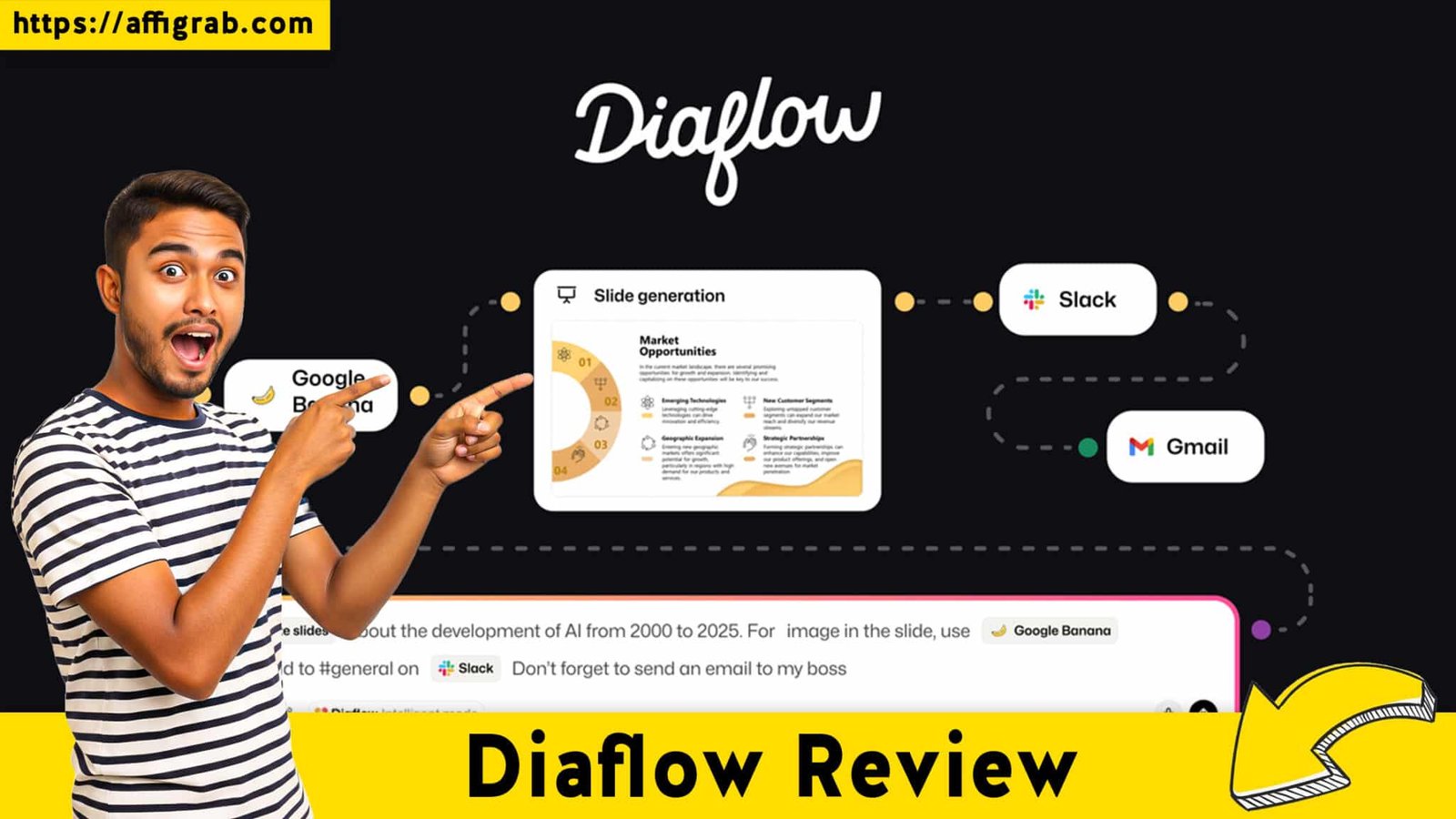
Diaflow Review enthusiasts and business owners are quickly realizing that the landscape of digital productivity has shifted dramatically as we move through 2026. In an era where speed and precision are the primary currencies of success, the traditional methods of manual data entry and disconnected software stacks are no longer viable. Businesses are currently facing a massive hurdle: the complexity of managing multiple artificial intelligence models while trying to maintain a cohesive workflow. This is where a sophisticated AI-powered platform becomes essential, acting as the central nervous system for modern operations.
Table of Contents
For years, companies have struggled with fragmented tools that require extensive coding knowledge to bridge. The “subscription fatigue” of 2025 has led to a desperate search for consolidated solutions that don’t just perform tasks but actually understand business logic. Diaflow enters the market as a robust answer to these challenges, providing a workspace where complex logic meets user-friendly design. It is designed specifically for those who want to leverage high-level intelligence without hiring a full team of developers to maintain the infrastructure.
Why AI Agents are Transforming Business in 2026
The shift from simple automation to autonomous AI agents is the defining trend of this year. Unlike the basic triggers of the past, modern agents can perceive, reason, and act within a digital environment to achieve specific goals. This evolution means that a “Diaflow Review” isn’t just about a new piece of software; it’s about a fundamental change in how work is distributed between humans and machines. By utilizing a visual workflow builder, users can now map out these complex journeys without looking at a single line of code, making the power of large language models accessible to marketing teams, HR departments, and operations managers alike.

The primary problem Diaflow solves is the “integration gap.” Most businesses have their data trapped in silos—spreadsheets, emails, and isolated databases. In 2026, the competitive advantage goes to those who can connect these silos and allow an AI to interact with them in real-time. This tool provides the bridge, allowing for the creation of custom assistants that can pull data from one source, process it using the latest LLMs, and then push an output to a client-facing application or an internal dashboard.
Overcoming the Barrier of Technical Complexity
One of the most significant roadblocks to AI adoption has always been the technical barrier to entry. Many platforms claim to be “no-code,” but they often require a deep understanding of API structures and JSON formatting. Diaflow addresses this by emphasizing internal app development that feels intuitive. Instead of complex configuration screens, users interact with a canvas that mirrors how they think about their business processes. If you can draw a flowchart on a whiteboard, you can build a functional AI agent within this ecosystem.
This democratization of technology means that the person closest to the problem—the project manager or the customer success lead—can be the one to build the solution. In 2026, we are seeing a move away from centralized IT bottlenecks toward a model of “citizen development,” where every department has the tools to optimize their own efficiency.
Scaling Operations Without Increasing Headcount
A common concern for growing startups is the linear relationship between growth and payroll. Typically, more clients meant more support staff and more manual oversight. Diaflow breaks this cycle by allowing for no-code automation that scales horizontally. Once a workflow is established and tested, it can handle ten tasks or ten thousand tasks with the same level of consistency. This scalability is crucial for businesses looking to remain lean while maximizing their output in a hyper-competitive global market.
The Architecture of a Modern AI Ecosystem
To understand why this tool is gaining such traction in 2026, one must look at its underlying architecture. It isn’t just a wrapper for a single AI model; it is a comprehensive environment that supports multiple integrations and data types. This flexibility is vital because the “best” AI model for a task today might be outperformed by another next month. By providing a platform that is model-agnostic, Diaflow ensures that your automated workflows are future-proof.
The integration of advanced logic handling means that these agents can perform multi-step reasoning. For example, an agent can be programmed to monitor a support inbox, categorize the sentiment of an incoming email, search a knowledge base for the correct answer, and draft a personalized response for a human to approve. This level of sophistication was a pipe dream just a few years ago but is now a standard expectation for any serious Diaflow Review.
Centralizing Data for Intelligent Output
At the heart of any effective AI system is data. However, raw data is often useless unless the AI can navigate it efficiently. The ability to connect various data sources directly into the workflow allows the AI to have “context.” This context is what prevents the generic, “hallucinated” responses that plagued earlier versions of AI tools. By grounding the AI in the specific facts of your business—your product catalogs, your SOPs, and your historical data—the output becomes infinitely more valuable and reliable.
The Impact on Professional Services
In sectors like legal, accounting, and consulting, the impact of such a platform is transformative. Professionals can automate the “drudge work” of document review and data reconciliation, freeing them up to focus on high-level strategy and client relationships. In 2026, the most successful firms are those that use these tools to augment their human expertise rather than replace it. The efficiency gains realized through these automated systems often result in higher profit margins and faster turnaround times for clients, creating a win-win scenario for all stakeholders involved.
Deep-Dive into Diaflow Features and Live AppSumo Pricing
Diaflow Review enthusiasts are quickly discovering that this platform is not just another wrapper for existing models, but a comprehensive environment for building sophisticated AI solutions. In 2026, the demand for a centralized AI-powered platform has skyrocketed, and Diaflow answers this call by offering a suite of tools that manage everything from data ingestion to user-facing applications.
One of the standout features of this system is the visual workflow builder, which allows users to drag and drop different logic blocks to create complex reasoning chains. For example, a real estate agency could use this to create an automated lead qualification agent that asks prospective buyers about their budget, preferred location, and timeline, then cross-references this data with a property database to provide instant, personalized recommendations.
The core strength of the platform lies in its ability to facilitate internal app development without requiring a dedicated DevOps team. Businesses can build custom portals for their employees or clients that interact directly with AI agents. A marketing department might develop an internal tool that generates social media captions, blog outlines, and email subject lines based on a single product description. Because the platform supports multi-LLM integration, users are not locked into one provider; they can switch between GPT-4, Claude 3.5, or open-source models depending on which one provides the best performance for a specific task. This flexibility is essential for maintaining high-quality output while managing API costs effectively.
Detailed Feature Analysis and Real-World Use Cases
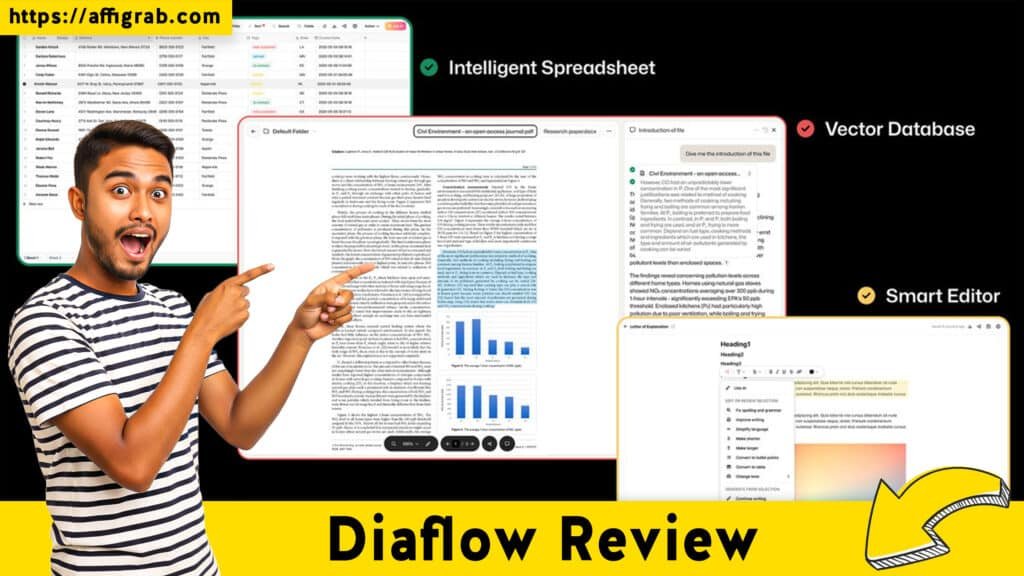
The transition to no-code automation is made seamless through the use of natural language prompts. Instead of writing complex scripts, users can simply describe what they want the AI to do. This is particularly useful for administrative tasks, such as summarizing long meeting transcripts or extracting key action items from a series of emails. By using a Vector Database, Diaflow allows these agents to “remember” information and provide contextually relevant answers.
For instance, a law firm can upload thousands of pages of case law into a private knowledge base. When an attorney asks a question about a specific legal precedent, the AI can query the vector store to find the most relevant documents and summarize the findings, drastically reducing research time.
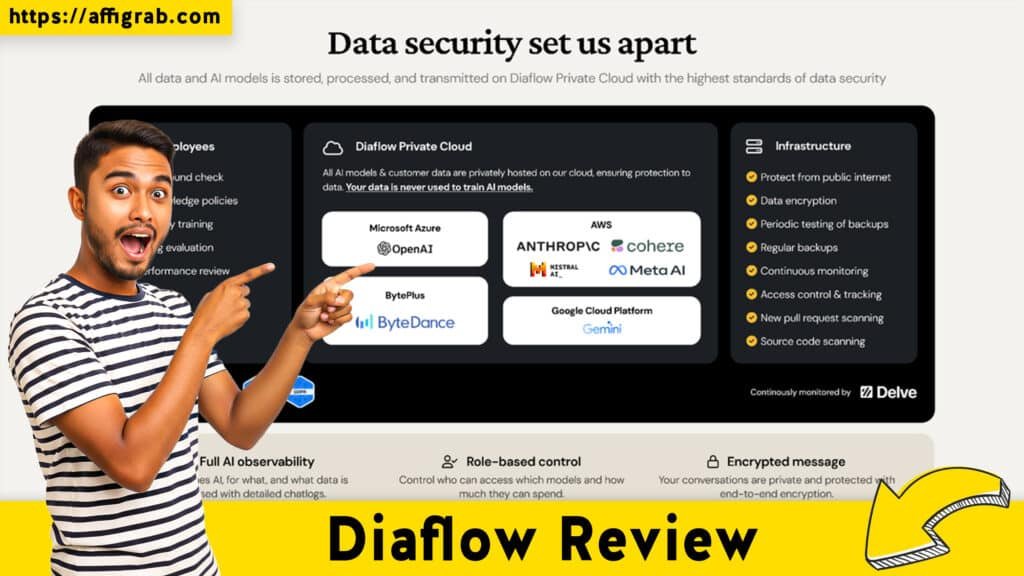
Another critical component is the focus on enterprise-level security. In an era where data privacy is paramount, businesses need to know that their proprietary information is protected. Diaflow ensures that data used for training or inference remains within the designated environment, preventing sensitive company secrets from leaking into public models. This level of control allows even highly regulated industries, such as healthcare or finance, to engage in business process automation with confidence. A financial services company could automate the first level of fraud detection by creating an agent that flags suspicious transaction patterns and alerts a human reviewer, all while keeping client data encrypted and secure.
Understanding the Diaflow Review of Workflow Capabilities
When we look deeper into the architecture, the ability to eliminate recurring subscription costs for multiple disparate tools becomes a major selling point. Instead of paying for a separate chatbot builder, a separate automation tool, and a separate data analysis platform, everything is consolidated. The system’s ability to handle multi-step logic means it can execute sequences that involve conditional branching. For example, if a customer’s sentiment in a support ticket is “angry,” the workflow can automatically escalate the ticket to a human manager. If the sentiment is “happy,” the AI can thank the customer and provide a link to a referral program.
The integration of advanced data handling also means that the platform excels at “RAG” (Retrieval-Augmented Generation). This is where the AI doesn’t just rely on its pre-trained knowledge but actively looks up information from your specific files or websites. A software company could use this to power its documentation search. When a developer asks how to implement a specific API call, the AI searches the latest documentation and provides a code snippet that is guaranteed to be up-to-date, unlike a general AI that might be using training data from a year ago.


Exact AppSumo License Tiers and Live Pricing
For those looking to secure a lifetime deal, the current AppSumo offering provides several tiers designed to scale with your business needs. Each tier includes lifetime access to Diaflow and all future updates associated with that plan. Here is the breakdown of the exact pricing and limits available right now:
License Tier 1: $89
This entry-level tier is perfect for individual entrepreneurs or small startups looking to experiment with AI agents. It includes all core features of the platform, allowing you to build and deploy your first set of automations. At this level, you get access to the visual builder and the ability to connect basic data sources. It is an excellent way to replace several smaller apps and reduce your monthly overhead while gaining experience in the world of autonomous agents.
License Tier 2: $169
The second tier is designed for growing businesses that require more robust capabilities and higher usage limits. It significantly increases the number of AI executions and data storage capacity allowed per month. This tier is often chosen by small agencies that need to manage multiple internal projects or a few client-facing agents. It provides a more generous allowance for vector storage, making it suitable for those who need to process larger volumes of documents or maintain a more extensive knowledge base.
License Tier 3: $329
As you move into the third tier, the platform becomes a true powerhouse for departmental use. This plan offers substantially higher limits on agents, workflows, and workspace members. It is ideal for mid-sized companies that want to roll out AI tools across different teams, such as sales, marketing, and customer support. The increased resource allocation ensures that even during peak usage times, your automated processes run smoothly without hitting performance bottlenecks.
License Tier 4: $639
The top-tier plan is built for enterprise-scale operations and heavy-duty automation. It provides the maximum limits available on the AppSumo platform, often including unlimited or very high caps on agents and executions. This is the choice for businesses that are fully committing to an AI-first strategy. With this tier, you can build an entire ecosystem of interconnected agents that handle everything from front-end customer interaction to back-end data processing and reporting. It offers the most comprehensive set of resources to ensure your business stays at the cutting edge of productivity in 2026.
Maximizing ROI with Lifetime Access
Choosing the right license tier depends largely on your projected volume of automated tasks. Since this is a lifetime deal, the primary goal is to move away from the burden of monthly software fees. By investing in a higher tier now, you lock in the ability to scale your operations without worrying about your costs increasing as your business grows. This predictability in budgeting is a significant advantage for any organization looking to maintain high margins while utilizing the most advanced technology available.
The value proposition of Diaflow becomes even clearer when you consider the cost of hiring a developer to build these types of integrations from scratch. A single custom AI project could easily cost thousands of dollars and take months to complete. With this platform, you can have a functional agent running in a matter of hours. The combination of the visual workflow builder and the ability to use natural language prompts means that the “time to value” is incredibly short, providing an immediate boost to your team’s output.
Future-Proofing Your Business Logic
In the fast-moving world of artificial intelligence, staying relevant requires the ability to adapt. Diaflow’s model-agnostic approach ensures that as newer, faster, and more intelligent LLMs are released, you can easily integrate them into your existing workflows. Your business logic—the “brain” of your automation—remains intact while you simply swap out the underlying engine. This ensures that your investment in building these systems today will continue to pay dividends for years to come, long after the initial AppSumo purchase.
By centralizing your business process automation within a single, secure, and flexible environment, you are doing more than just saving time; you are building a scalable asset for your company. Whether you are a solo founder looking to automate your marketing or a large corporation seeking to optimize internal workflows, the various license tiers offer a path to increased efficiency that fits your specific budget and requirements. The 2026 digital economy rewards those who can operate with speed and intelligence, and this tool provides the necessary infrastructure to do exactly that.
Competitor Analysis, FAQ & Final Verdict
As the 2026 automation landscape evolves, conducting a thorough Diaflow Review requires looking at how it stands against the established giants. While Diaflow offers a unique “AI-first” approach, several competitors provide similar workflow orchestration. Below is an analysis of three primary alternatives and how they compare in terms of value and technical capability.
1. Zapier
Zapier remains the industry titan with over 7,000 integrations.
- Pricing: Currently starts at $29.99 per month for the Professional plan (billed monthly).
- Model: Monthly Subscription (SaaS).
- Comparison: Zapier is more mature with “Instant Triggers” for niche apps, but it is significantly more expensive. Unlike Diaflow, Zapier treats AI as an add-on step. To get advanced logic like “Paths,” you must stay on their high-tier monthly plans, whereas Diaflow includes complex logic in all lifetime tiers.
2. Make.com
Make (formerly Integromat) is known for its highly visual and granular “bubble” interface.
- Pricing: Starts at approximately $10.50 per month (Core plan, billed monthly).
- Model: Monthly Subscription (SaaS).
- Comparison: Make offers more granular control for developers, but it has a much steeper learning curve. Diaflow’s visual workflow builder is more intuitive for 2026 standards, and the lack of a recurring subscription cost on the AppSumo deal gives Diaflow a massive ROI advantage for long-term projects.
3. Pabbly Connect
Pabbly is the most direct competitor for those seeking a lifetime deal.
- Pricing: Lifetime plans start at $249 (one-time payment) for 3,000 tasks/month.
- Model: Lifetime Deal.
- Comparison: While Pabbly offers a lifetime model, it lacks the integrated AI-powered platform features found in Diaflow. Pabbly is primarily rule-based; it does not have a built-in Vector Database for RAG or a native multi-LLM integration ecosystem, making it feel more like a 2024 tool compared to Diaflow’s 2026-ready AI agents.
Pros & Cons
Pros:
- Zero Monthly Fees: One-time payment for lifetime access to advanced AI orchestration.
- AI-Native Design: Built-in Vector Database for long-term memory and RAG capabilities.
- Flexibility: Supports multi-LLM integration (OpenAI, Claude, Gemini, Llama) in one dashboard.
- Speed of Deployment: Build complex agents using natural language prompts and a “Co-Pilot” assistant.
- White-Labeling: Higher tiers allow you to remove branding and resell AI tools to clients.
Cons:
- Credit System: Unlike “unlimited” rule-based tools, AI executions consume credits based on token usage.
- Newer Platform: Fewer native integrations (500+) compared to Zapier’s thousands.
- Learning Curve: While no-code, mastering agentic workflows requires a shift in mindset from simple triggers.
FAQ: Common Questions about Diaflow
Q: What exactly are “Credits” and how do they reset?
Credits measure the processing power used by your no-code automation. Each time an AI agent processes data, converts a PDF, or queries the Vector Database, it consumes a small amount of credits. On the AppSumo deal, your credit balance resets every month, ensuring you have a fresh allowance for your business process automation.
Q: Can I use my own API keys (BYOK) if I run out of credits?
Yes. One of the best features for scaling is the “Bring Your Own Key” (BYOK) option. If you exhaust your monthly credits but need to keep your agents running, you can plug in your own OpenAI or Anthropic keys. This ensures your internal app development never hits a hard wall during busy months.
Q: Does Diaflow support HIPAA or GDPR compliance for data privacy?
By default, Diaflow is designed with enterprise-level security in mind. It hosts models on secure US-based cloud servers (AWS/Azure) and complies with GDPR. For sensitive industries, your data is not used to train the underlying LLMs, keeping your proprietary logic private.
Q: How does the “Vector Database” feature work for my business?
This allows your AI agents to have “contextual memory.” You can upload your company’s SOPs, PDFs, or spreadsheets. The agent uses the Vector Database to find relevant facts before generating an answer, which eliminates hallucinations and makes the output highly accurate for your specific niche.
Q: Can I build a public-facing chatbot for my website with this?
Absolutely. Beyond internal app development, Diaflow allows you to publish your workflows as Public Apps or embeddable chatbots. This is perfect for lead generation, customer support, or creating “tools as a service” for your audience.
The Diaflow Review Verdict: Is it Worth it?
In 2026, the cost of AI is the single biggest overhead for digital agencies and solopreneurs. Diaflow Review results clearly show that this is the most strategic investment you can make this year to eliminate recurring subscription costs. While Zapier and Make are excellent tools, they are built on an old “if-this-then-that” architecture. Diaflow is built for the era of “Agentic Automation.”
The ability to combine avisual workflow builder, a Vector Database, and multi-LLM integration into a single one-time payment is an opportunity that rarely lasts. If you want to build a scalable, AI-driven business without the weight of monthly bills, the Diaflow AppSumo deal is an absolute must-buy. It is the bridge between simple automation and true artificial intelligence.
Final Verdict: Highly Recommended. Secure Tier 3 or higher for the “Unlimited Flows” and White-Label features to future-proof your business.
TextLink Review: Best Lifetime SMS Marketing Deal (2026)