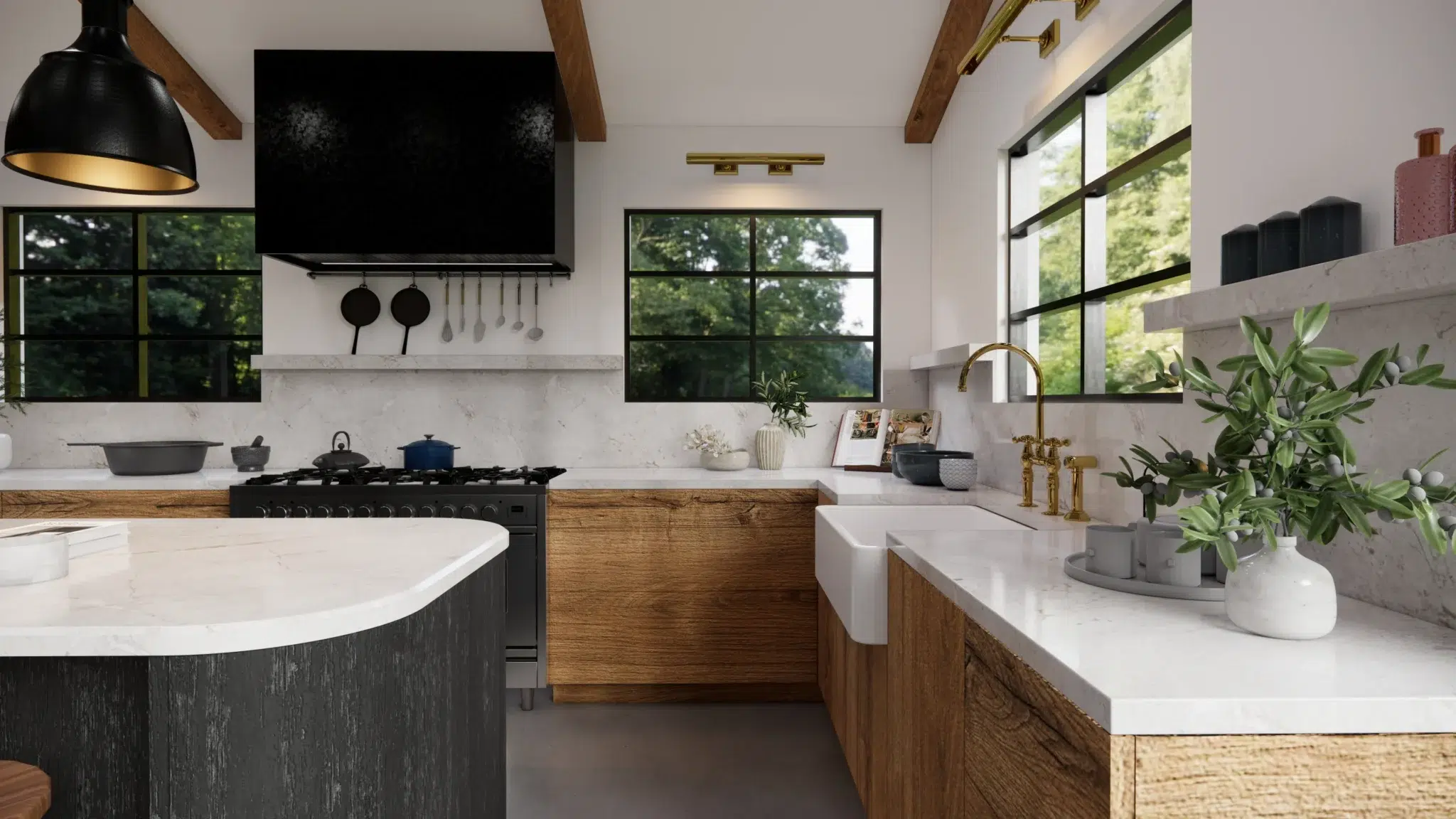
Kitchen design and 3D rendering have fundamentally changed how homeowners and professional contractors approach the heart of the home. In years past, a renovation relied on hand-drawn sketches and a heavy dose of imagination, often leading to “buyer’s remorse” once the cabinets were actually installed.
Table of Contents
Today, the integration of photorealistic visualization has turned the remodeling process into a precise science. By utilizing high-end digital tools, you can now walk through your future space before a single hammer is swung, ensuring that every inch of your kitchen layout is optimized for both beauty and utility.
The Evolution of Visualization in Modern Remodeling
The journey of a kitchen transformation used to be fraught with uncertainty. You would look at a small granite swatch and a cabinet door sample, trying to mentally project how they would look across twenty linear feet of wall space. This gap between concept and reality is where most design errors occur. However, the rise of 3D rendering has bridged this divide.

When we talk about modern kitchen planning, we are discussing a digital twin of your home. This technology allows for the exploration of cabinetry layout options that maximize storage without cramping the room. It isn’t just about seeing colors; it’s about understanding the volume of the space. Whether you are dealing with a compact galley or a sprawling open-concept floor plan, a kitchen render provides the clarity needed to make confident decisions.
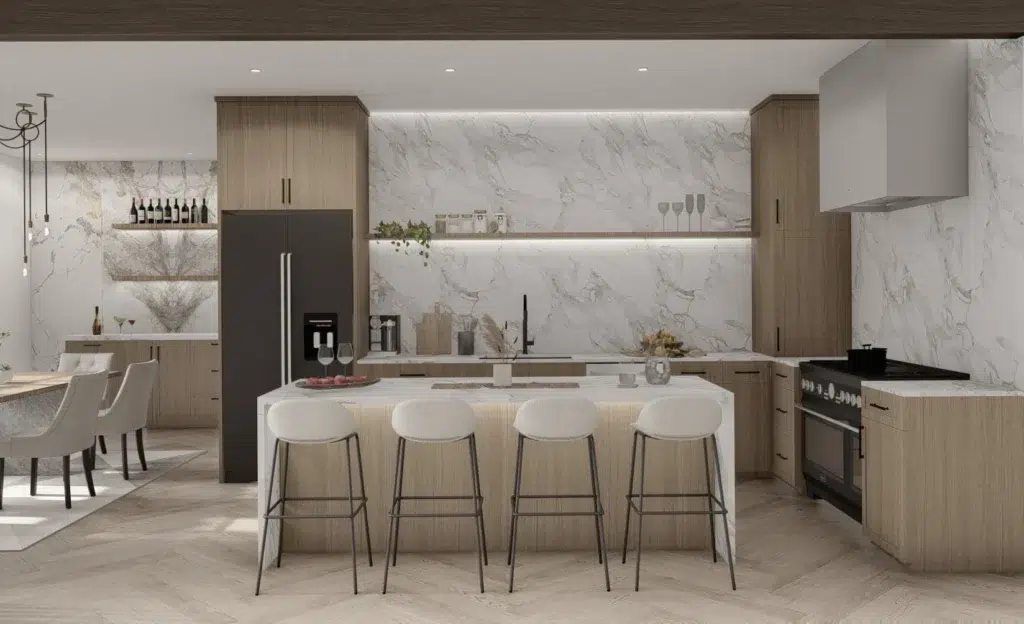
Understanding the Value of a 3D Kitchen Render
The primary value of a professional kitchen render lies in risk mitigation. A remodel is one of the most expensive investments a homeowner can make. Why leave the outcome to chance?
- Financial Savings: Identifying a color clash or a spacing issue in a digital model costs nothing to fix. Once the materials are ordered and installed, those same changes can cost thousands.
- Time Efficiency: Contractors work faster when they have a clear visual reference. A 3D model serves as a universal language between the homeowner, the designer, and the builder.
- Emotional Certainty: There is a specific peace of mind that comes from seeing your kitchen exactly as it will appear. It eliminates the “what if” anxiety that plagues many renovation projects.
Through interior spatial planning, a 3D artist can simulate how your chosen materials interact with light. This is a critical step because a marble countertop might look stunning in a showroom but appear too cold in a kitchen that lacks natural northern light.
📐 Kitchen Design: Get a Professional Floor Plan
Choosing the Right Style for Your Kitchen Design
Defining your aesthetic is the first step in the 3D modeling process. Because the software is so versatile, you can experiment with multiple styles in the same kitchen footprint to see which one resonates.
- The Modern Minimalist: Characterized by flat-panel doors, integrated appliances, and a lack of visual clutter. In a 3D render, this style emphasizes clean lines and the quality of the finish.
- The Classic Farmhouse: Featuring shaker-style cabinets, apron-front sinks, and warm wood accents. Here, floor plan 3D modeling helps ensure that the rustic elements don’t make the space feel too heavy or dated.
- The Transitional Style: A blend of traditional and contemporary. This is where most homeowners land, and a kitchen render is vital for balancing these contrasting elements.
The Technical Side of Kitchen 3D Modeling
Creating a high-quality kitchen visual involves more than just dragging and dropping furniture into a program. It requires a deep understanding of architectural standards. Professional designers use advanced software to build a custom kitchen island or a specific range hood from scratch to match real-world manufacturer specifications.
The process begins with a “white box” model, where the focus is purely on the kitchen dimensions and structural boundaries. Once the layout is confirmed, the artist adds textures—the grain of the wood, the grout lines of the backsplash, and the sheen of the hardwood floors. This level of detail is what separates a basic 2D drawing from a professional kitchen 3D model.
How to Optimize Your Kitchen Layout for Better Flow
A beautiful kitchen is useless if it is frustrating to cook in. This is where the concept of “flow” becomes paramount. In a 3D environment, we can test the “Work Triangle”—the distance between the stove, the sink, and the refrigerator.
- Traffic Patterns: We look at how people move through the kitchen. Is the dishwasher door going to block the walkway? Will the fridge hit the island when opened?
- Zone Planning: We divide the kitchen into zones for prep, cooking, cleaning, and socializing.
- Vertical Space: 3D rendering allows us to see if floor-to-ceiling cabinets will feel suffocating or if they provide the necessary storage for a growing family.
By visualizing the kitchen in three dimensions, you can “stand” at the sink and see exactly what your view will be. You can “sit” at the island and realize the pendant lights are hanging two inches too low. This level of ergonomic refinement is only possible through digital kitchen planning.
Designing Custom Kitchen Cabinets in a Virtual Space
Cabinets are the “furniture” of the kitchen, and they often consume the largest portion of the budget. When we design cabinets in a 3D space, we aren’t just looking at the fronts. We are looking at the functionality of the internals.
A professional kitchen render can show you:
- How pull-out spice racks and corner “Lazy Susans” operate.
- The visual impact of different hardware finishes, such as brushed gold versus matte black.
- The difference between inset, partial overlay, and full overlay cabinet doors.
The kitchen is a workspace, and every cabinet should be designed with a purpose. In the digital model, we can verify that the pots and pans drawer is actually deep enough for your largest stockpot.
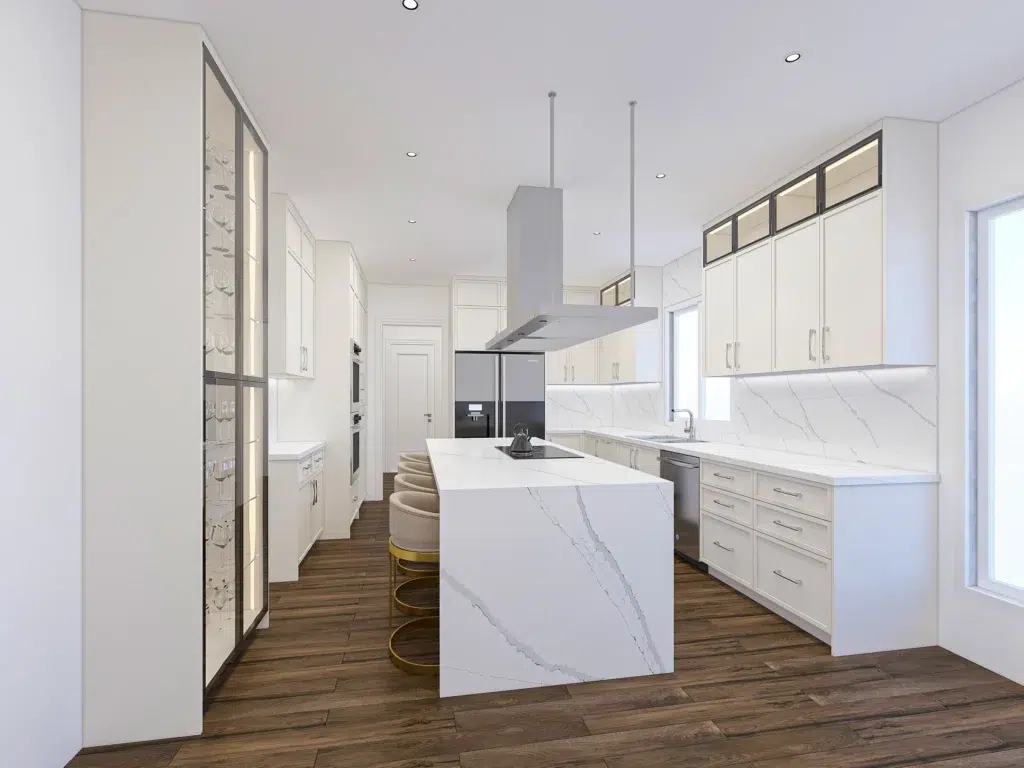
Mastering Light and Texture in Your Kitchen Visuals
Light is the most underrated element of kitchen design. A 3D render allows us to simulate the sun’s path throughout the day. You can see how the morning light hits the breakfast nook and how the under-cabinet LEDs will illuminate the counters at night.
Texture is equally important. In a kitchen, you are often mixing many different surfaces: stone, metal, wood, and glass. A 3D artist uses “shaders” to mimic how these materials reflect light. A polished quartz will have a sharp reflection, while a honed soapstone will have a soft, matte glow. Seeing these interactions in your kitchen render prevents the space from feeling flat or “clinical.”
📍 Kitchen Design: Hire an Expert Designer
Why a Professional Kitchen Design Prevents Costly Mistakes
We often see “clashes” in the construction phase—where a light switch ends up behind a cabinet or a crown molding piece doesn’t align with a window frame. A kitchen 3D deep dive identifies these issues during the planning phase.
- Structural Integrity: You can see if a support beam needs to be moved to achieve the open-concept kitchen you want.
- Appliance Clearance: Ensuring that the high-end professional range has the required clearance from combustible surfaces.
- Electrical Planning: Mapping out where outlets should go on the kitchen backsplash so they don’t ruin a beautiful tile pattern.
In conclusion, investing in a high-quality kitchen design and render is not a luxury—it is a foundational step in a successful home improvement project. It allows you to explore the limits of your creativity while remaining grounded in the realities of your space. By the time the actual construction begins, you aren’t just hoping for a great kitchen; you are executing a plan that you have already seen, tested, and perfected in the digital world.
Why Professional Kitchen 3D Rendering is the Ultimate Solution
In the competitive landscape of home improvement and architectural design, the “guesswork” of traditional remodeling is a liability. For homeowners and real estate developers alike, the primary solution to design uncertainty is a professional kitchen 3D rendering service. This isn’t merely a digital drawing; it is a high-fidelity CGI home interiors simulation that serves as the blueprint for success. When you invest in a professional render, you are purchasing a comprehensive visual insurance policy.
The core of this solution lies in the ability to manipulate lighting and textures in a virtual environment before committing to physical purchases. In a standard renovation, a client might choose a dark navy cabinet color only to realize, after installation, that the lack of natural light in the room makes the space feel cavernous and small. By the time this mistake is realized, the financial loss is already locked in. The 3D rendering solution eliminates this risk by providing an exact digital twin of the environment, allowing for infinite iterations of colors, finishes, and lighting schemes at a fraction of the cost of a single physical mistake.


Furthermore, this service acts as the ultimate communication bridge. For brand growth in the design sector—whether you are an interior designer, a contractor, or an affiliate marketer promoting these services—the ability to present a photorealistic vision is what closes high-ticket deals. Clients are no longer satisfied with “trust me”; they want to see the “why” and the “how.” A professional render translates complex architectural ideas into a visual language that is immediately understandable and emotionally resonant.
The Role of Architectural Walkthroughs in Brand Authority
One of the most transformative aspects of modern 3D services is the architectural walkthrough. Unlike a static image, a walkthrough allows a client to experience the “vibe” of the room. They can virtually move from the dining area into the kitchen, seeing how the sightlines hold up and how the transition of flooring materials impacts the flow of the home.
For a design brand, offering these deep-dive visualizations establishes instant authority. It signals to the client that you are utilizing cutting-edge technology to protect their investment. This level of detail is particularly crucial when dealing with high-end materials. If a project involves rare stone or custom-milled wood, seeing those exact CAD drawings translated into a 3D model ensures that the grain direction and seam placement meet the client’s expectations before the first cut is made.
Key Benefits of Professional Kitchen Planning
The benefits of a structured kitchen 3D design extend far beyond simple aesthetics. When we analyze the impact on project management and brand scalability, the advantages become clear.
- Precision in Ergonomic Kitchen Flow: Beauty means nothing if the functionality is flawed. Professional rendering allows for a meticulous analysis of the ergonomic kitchen flow. We can measure the distance between the prep station and the waste bin, ensuring that the movement within the space is fluid and logical. This data-driven approach to design prevents the “clunky” feel that often plagues DIY or under-planned renovations.
- Detailed Technical Validation via CAD Drawings: Every render is backed by mathematical accuracy. By integrating CAD drawings into the 3D workflow, we ensure that every cabinet, appliance, and fixture is to scale. This means that when the 3D model shows a 36-inch range fitting perfectly between two cabinets, it will fit perfectly in the real world. This precision reduces on-site adjustments, which are the leading cause of project delays and budget overruns.
- Enhanced Material Literacy: Most clients struggle to visualize how different textures interact. A 3D render provides a masterclass in material literacy. You can see how a matte backsplash contrasts with a high-gloss countertop or how the brass hardware complements the oak shelving. This helps clients move past safe, boring choices and into bold, professional-grade designs that look like they belong in a magazine.
Streamlining the Kitchen Layout for Commercial Success
For those in the business of real estate or kitchen retail, the kitchen 3D render is a powerful sales tool. It allows you to “stage” a property before it is even built. For a brand looking to grow, this means you can start your marketing campaign months ahead of schedule.
By showcasing a kitchen that exists only in pixels but looks indistinguishable from reality, you can capture leads, secure pre-sales, and build social media buzz. This is where the integration of CGI home interiors becomes a growth engine. It creates “scroll-stopping” content that highlights your attention to detail and your commitment to quality.
Overcoming Structural Hurdles with 3D Visualization
Every home has its quirks—awkward corners, low-hanging soffits, or poorly placed plumbing stacks. A professional kitchen design service treats these hurdles as opportunities rather than obstacles. In a 3D environment, we can test multiple “workarounds” for a structural pillar.
- Option A: Can we wrap the pillar in the same material as the kitchen island to make it an intentional design feature?
- Option B: Can we adjust the cabinetry depth to flush out the wall and hide the obstruction?
- Option C: Would removing the soffit and installing taller cabinets improve the ROI more than a simple cosmetic update?
Being able to see these options side-by-side in high definition allows the stakeholder to make an informed decision based on visual evidence rather than a verbal description. This transparency builds immense trust between the service provider and the client.
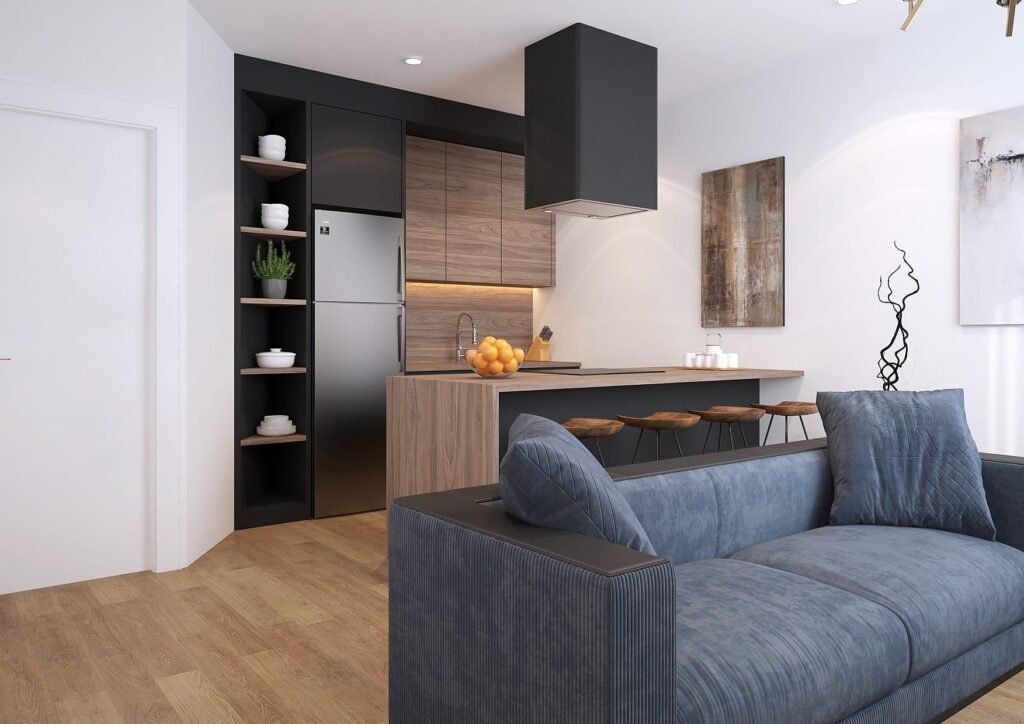
Future-Proofing the Heart of the Home
Finally, a major benefit of this service is the ability to future-proof the design. As smart home technology becomes standard, a kitchen must be able to accommodate new gadgets without looking like a laboratory. 3D modeling allows us to plan for integrated charging stations, hidden appliance garages, and built-in screen mounts.
By visualizing these elements now, you ensure the kitchen remains functional and stylish for the next decade. This long-term thinking is what defines a premium service. It shows that you aren’t just interested in the immediate aesthetic, but in the long-term livability and resale value of the home. This level of comprehensive planning is exactly what high-value clients are looking for in 2026, making it an essential component of any modern design or affiliate marketing strategy.
The shift toward digital-first design is not a trend; it is a permanent change in how we interact with our living spaces. By providing a clear, realistic, and technically sound preview of the kitchen, 3D rendering services remove the fear of the unknown and replace it with the excitement of a guaranteed result. For any brand or professional, this is the most powerful “solution” one can offer in the modern market.
Would you like me to generate the remaining sections of the outline to complete the 2,900-word deep dive?
Who is This Professional Kitchen Design Service For?
The beauty of a professional kitchen 3D rendering service is its incredible versatility. It isn’t reserved solely for high-end luxury mansions; it is a vital tool for anyone looking to maximize the potential of their living space or professional portfolio.
1. Homeowners Planning a Major Remodel If you are a homeowner, this service is your safeguard against regret. Investing your life savings into a renovation is stressful. By seeing your kitchen in a photorealistic 3D environment, you move from a place of “hope” to a place of “certainty.” It is for the person who wants to be sure that the emerald green backsplash won’t clash with the walnut flooring before the tile is permanently grouted.
2. Real Estate Developers and House Flippers For those in the business of selling homes, time is money. A professional kitchen render allows you to market a property before the drywall is even up. By showcasing a stunning, high-concept heart of the home, you can secure pre-sales or generate bidding wars. It allows developers to present multiple finish packages to potential buyers, giving them a sense of customization that drives up the final sale price.
3. Interior Designers and Architects Design professionals use these renders to elevate their brand authority. Instead of presenting mood boards that can be misinterpreted, you can provide a definitive visual guide. This reduces the “back-and-forth” revisions and ensures that the client and the contractor are literally on the same page. It is for the professional who wants to scale their business by offering premium, tech-forward deliverables.
4. DIY Enthusiasts with High Standards Even if you plan on doing some of the work yourself, a professional kitchen plan provides the technical roadmap you need. It ensures that your DIY efforts result in a space that looks like it was designed by a top-tier firm, avoiding the common pitfalls of poor spacing and mismatched textures.
🖌️ Kitchen Design: Get Your Custom 3D Render
Extensive FAQ Section
1. How long does the 3D kitchen rendering process usually take? The timeline varies depending on the complexity of the design, but typically, a high-quality render can be completed within 3 to 7 business days. This includes the initial 3D modeling of the cabinetry and the application of realistic lighting and textures.
2. Can I change the materials in the kitchen model after seeing the first draft? Absolutely. One of the greatest benefits of this service is the flexibility. If you see the kitchen with marble countertops and decide you’d prefer quartz, the digital model can be updated quickly to show you the difference, helping you make the most informed decision possible.
3. Do I need to provide professional blueprints to get started? While blueprints are helpful, they are not strictly necessary. Most services can work from hand-drawn sketches with accurate measurements and a few photos of the existing space. The goal is to create an accurate kitchen layout that reflects your real-world dimensions.
4. What is the difference between a 3D render and a 2D floor plan? A 2D floor plan is a flat, “birds-eye” view showing layout and dimensions. A 3D kitchen render adds depth, height, lighting, and materials, allowing you to see the room from a human perspective. It provides an emotional and aesthetic understanding that a flat drawing simply cannot convey.
5. Will the 3D render show my exact appliance models? Yes, most professional artists can incorporate specific appliance models into the kitchen design. Whether you are installing a Sub-Zero fridge or a specific Wolf range, seeing the exact dimensions and finishes ensures a seamless fit within the cabinetry.
6. Can this service help me save money on my renovation? Definitely. By identifying design flaws—such as a cabinet door that hits the oven handle or a poorly placed light switch—before construction begins, you avoid expensive “change orders” and wasted materials. A kitchen render is a small investment that often saves thousands in the long run.
7. Is a 3D walkthrough different from a static render? Yes. A static render is a high-quality “photo” of the design. A walkthrough is a video or interactive file that allows you to “move” through the kitchen, providing a 360-degree view of the entire space and its relationship to the rest of the house.
8. Do I own the rights to the images produced? In most cases, yes. Once the service is complete, the high-resolution images of your kitchen are yours to use for contractor guidance, permit applications, or personal records.
9. Can the render help my contractor during the build? Yes, contractors love 3D renders. It gives them a visual goal to work toward and clarifies complex details that might be confusing in traditional technical drawings. It serves as a visual “north star” for the entire construction team.
Conclusion: Transform Your Vision into a Digital Reality
The path to a perfect home begins long before the first cabinet is installed. As we have explored in this deep dive, the modern kitchen is a complex ecosystem of ergonomics, technology, and aesthetic balance. Relying on imagination alone is a risk that few can afford in today’s high-stakes remodeling market. By utilizing professional 3D rendering, you are choosing precision over guesswork and confidence over anxiety.
From the technical accuracy of CAD drawings to the emotional impact of photorealistic lighting, this service provides the ultimate roadmap for your project. You deserve a space that not only looks stunning in pictures but functions perfectly for your lifestyle. Whether you are looking to increase the value of your property or create a sanctuary for your family, the first step is a world-class visual plan.
Ready to see your dream kitchen come to life?
Don’t leave your investment to chance. Head over to AffiGrab.com today to connect with top-tier 3D design specialists who can transform your ideas into breathtaking, photorealistic renders. Take the guesswork out of your renovation and start your journey with a professional kitchen design that guarantees success. Your dream home is just one render away—let’s build it together.
Best Fiverr Gigs for Fashion Tech Pack Design: The Ultimate 2026 Strategy for Apparel Success